Showing posts with label Balarama. Show all posts

Thursday, September 2, 2021

Revival of Indus Valley/Harappan/Sarasvati hieroglyphs on the earliest known Indian coins


The Indus Valley Civilization was established around 6000 BCE. Two main cities of the Harappan civilization Harappa and Mohenjadaro were built around 2600 BCE, and thrived till around 1900 BCE, when they were abandoned. This period corresponds to what is known as the Mature Harappan Phase.

The earliest coins however, were minted much later in the 6th / 5th century BCE.


The Unicorn Bull is the most common motif on the Indus seals

The Indus Valley Civilization is sometimes called the Sarasvati Culture, the Sarasvati Civilization, the Indus Sarasvati Civilization or the Sindhu Sarasvati Civilization and it is tempting to equate Indus Valley and Vedic cultures.


In the Manu Smriti, the Drishadvati and the Saraswati rivers define the boundaries of the Vedic state of Brahmavarta. It says ''the land created by the Gods, which lies between the two divine rivers Saraswati and Drishadvati''. Also, Sarasvati formed the northern boundary of Kuru Pradesh, and the Drishadvati flowed in southern Kuru Pradesh.


Sketch showing Sarasvati and Drishavati rivers
              

Mahabharata mentions Drishavati several times and mentions the southern boundary of Kuru Pradesh was Guru Drona's ashram (present day Gurgaon at one end and Rohtak and Jhajjar at the other), therefore Drishavati flowed south of these cities.


Map of northern India in the late Vedic period


The names of two Vedic rivers are Sindhu and Saraswati. River Sindhu is the lord of 11 rivers of which 7 were major rivers, hence the name Sapta Sindhu. Kalibangan and Mathura on the present Yamuna are indications of old Yama/Yamuna/kaali/hali nadi (Kalindi) associated with Yamuna, Kalibhangan, Ghaggar belt. The Kalindi/Yamuna belt was the cradle of early Vedic civilization sometime in the 3rd millennium BCE.


French Indologist Louis Renou's map of the Mahabharata age 


The early Vedic period settlements 1500-1100 BCE

For the Vedic people, Agni/soma/agnish Toma (the unicorn) had prime significance in their sacrificial/ritual life. They praised agni and the sun god in every way possible. 


Several scholars have overlooked the existence of Kalindi (Ghaggar/old vedic Yamuna) river and called it as Sarasvati. The Rig Veda shows Yamuna's link with Kalindi through channels/distributaries and Sutlej joining Ghaggar upto 2500 BCE. The name Yamuna continued to be use till the collapse of the Mature Harappan Phase. 


Indian Space Research Organization (ISRO) picture depicting Sarasvati River


Trade with Sumer has been established in the Vedic scripts.  


Indus Valley Civilization ''Painted Jar'' excavated in 1935-36 by Ernest Mackay at Chanhu-daro

There are remarkable parallels between the Sarasvati hieroglyphs and the symbols used on ancient Indian punch marked coins and, on the sign, graphs employed on Sohgaura copper plate inscription. 


Sohagaura copper plate, written in Prakrit in Brahmi script, 3rd century BC, discovered in Sohgaura, a village on the banks of river Rapti, 20 km south-east of Gorakhpur, Uttar Pradesh

Punch marked coins are the earliest Indian archaeological ''documents'' that exist. (600-500 BC)

To date about 1000 cities of the Indus Valley Civilization have been found, mainly in the general region of the Ghaggar-Hakra river and its tributaries and include Lothal, Dholivara, Ganweriwala and Rakhigarhi. Only about 100 of the more than 1000 have been discovered on the Indus and its tributaries. The Sutlej River, in Harappan times flowed into Ghaggar-Hakra river.


The Bearded Man, the famous stone sculpture of the Indus Valley Civilization

The word ''India'' and Hindu are derived from the Indus River, and the Bindi on the forehead is a mark of this Dindhu/Hindu/Vindu (Saraswati is the goddess of light, water and learning). In ancient times Hindustan referred to those regions east if the Indus River.


Pig figure, 2500-2000 BC, in British Museum, found in Mohenjo-daro


The collapse of the Harappan culture which began around 3900 years ago, has been linked to rapid weakening of the summer monsoon, along with the reorganization of the rivers due to the tectonic movements making people move to the fertile Yamuna-Ganga River belt and to southern areas of India. In the later Vedas, Brahmanas, Puranas and the epics, it is mentioned that due to the location change of active settlements from the Indus basin to the Ganga Yamuna basin, the prominence of Saraswati was taken up by the Ganga River. 

Through Balarama (elder brother of Krishna) the Mahabharata gives evidence of the life of the Harappans in two ways. First the shift from Mathura (Kalibangan/Kalindi) to Dwaraka (Mohenjodaro/Indus) to avoid Jarasandha (drought) and secondly, the shift from Dwaraka in search of tirtha (holy water) along the Yamuna-Gangetic basin.


Samkarsana, later known as Balarama on a coin of Agathocles of Bactria, 190-180 BC, with a Gada, Mace and a Plough.


The Script. One of the puzzling mysteries of the ancient world is the writing system of the Indus-Sarasvati civilization. The writing is too short mostly being four or five symbols long. There are over 4200 inscriptions found on seals, tablets and pottery. 


Some Indus Valley Civilization Symbols

The importance of the ''Unicorn'' is evident as three quarters of the seals found in the region have this inscribed. The Unicorn Bull is the most common motif on the Indus seals, representing the iconography of Krishna-Vishnu. This Vedic symbol is a bull combined with horse head with one stiff horn, a symbol of Krishna the ruler of Sarasvati Province. Even the Greek and Roman sources trace back on their coin motif of the same Unicorn Bull with a ritual offering Soma filter stand in front of it The influence is visible on the Greek and Romans as and when they came into contact with the language and script. 


The Unicorn Bull is the most common motif on the Indus seals, representing the iconography of Krishna-Vishnu. 


Elephant seal from Mohenjo-daro

India's first script which we can read is written in Brahmi. Many of the Asian scripts such as Burmese, Tibetan, Cham, Malayan, Javanese, Sumatran were all derived from Brahmi. There is a relationship between Brahmi, which has 48 letters and the Indus script which has more than 340 symbols. The primary characters of the Indus script (accounting to 80 percent symbols) totaling 39 is close to the letters in Brahmi. Also letters of Brahmi could be combined to produce modified symbols (about 200 and 300). The probability of the relationship. though not proved is high. Brahmi was therefore either derived from of was extensively influenced by the Indus script. The iconography found on Harappan seals were found in abundance on the punch marked coins of India. Many also survive on later coins of Ujjain and Eran and on the coins of the Janapadas


                        Brahmi Script 


The period between the Harappan and Gangetic cultures is not distinctly different, but has a continuity of change in iconography, culture and script. Brahmi and Kharosthi evolved from the Indus script and the Indus script was in use along with Brahmi/Kharosthi, even up to 1st century AD. 


Kharosthi letters on Graeco-Indian ancient coins

.

The Devanagari and the Brahmi script both have developed from the Sarasvati script. After the end of the Sarasvati civilization around 1900 BC, Devanagari, Brahmi, Kharosthi have remained as independent. Ashoka, the emperor gave popularity of the Brahmi script as it was the official language and easy to write the Prakrit language. But the Guptas, whose language was Sanskrit adopted a variant of the ancient Devanagari Brahmi script. Some important signs of the Devanagari are not available in the Brahmi, but the same is available in the Sarasvati script.


Pictorial representation on a seal. The first one is the Harappan Om, which when turned by 90 degrees becomes the Devanagari Om

Dr Jha and Rajaram in their research quote verses 23,27 and 28 of the Mahabharata refer to the Supreme bull (Vrsamuttamam) as Krishna-Vishnu. In the verse 342.73, Mahabharata discloses that an earlier version of the Nirukta (text containing meaning of the Vedic mantras) was buried due to floods. The text was recovered with the help of Krishna, who was the ruler.  


Now that we have authentic information on the Hindu Panchang. In the Hindu Panchang of September 2021, the Vikram Samvat is 2078 and the Kali Samvat is 5123 years from the year 2021, takes us to the year 3102 BC, the year when Krishna died. After the death of Krishna, and destruction of Dwarka, Arjun coronated the grandson of Krishna, Yuyudhan as the administrator of the Sarasvati Province. 

Mahabharata says 36 years before the death of Krishna, the Mahabharata war took place. This stands at 3138 BC. The Harappans were not different than Krishna himself, where the medium of conversation was Sanskrit. The iconography has been retained in South India too. Although there is no consensus amongst all historians, as some feel it was in the 7th to 8th millennium.

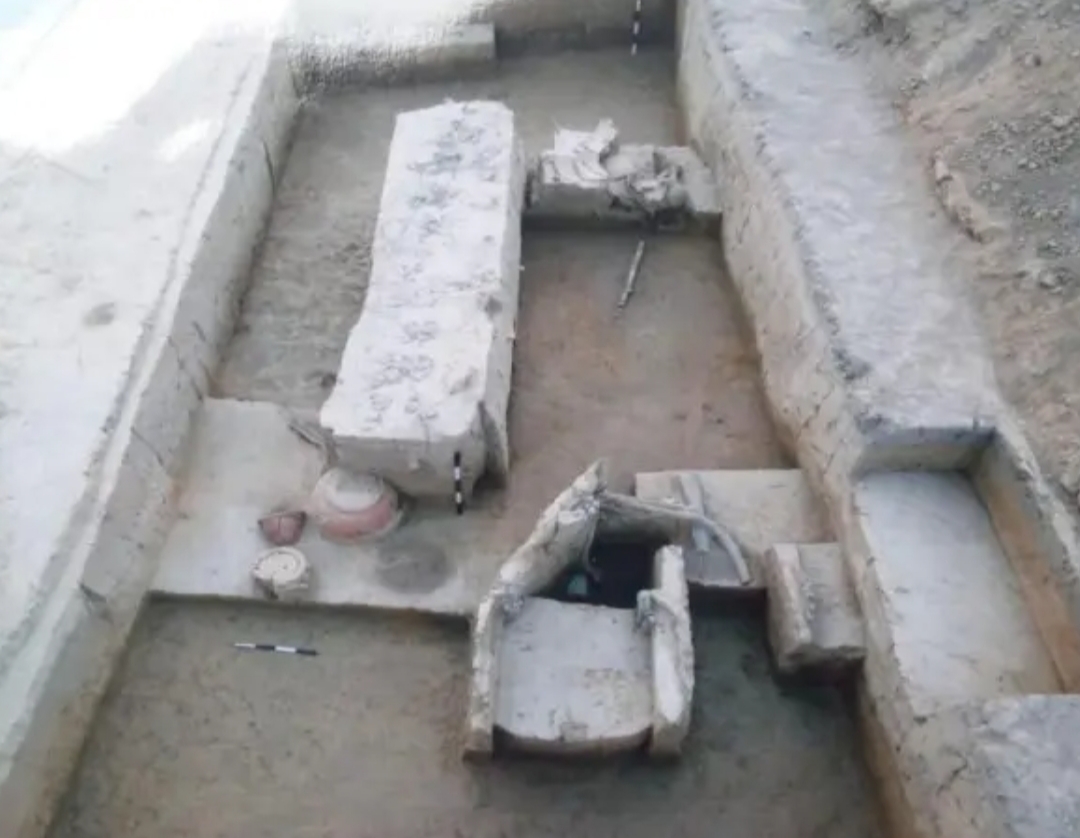
Sanauli, the new Harappan Site. The Archaeological Survey of India (ASI) recently excavated burial site in Uttar Pradesh's Sanauli. This unearthed ''sacred chambers'' decorated ''coffins'', rice and dal in pots, animal bones buried with bodies. shields and swords and copper made horse drawn chariots along with warrior. The coffin top is engraved with Pashupati and Aswath leaf sign. All these are Vedic practices.


Copper made horse drawn chariot


Two copper chariots buried with one warrior, coffin top is engraved with Pashupati and aswath leaf sign


Horse drawn carriage pole 


Picture depicting the type of Chariot unearthed at Sanauli
        

Indus Valley/ Harappan Script on ancient coins. The punch used to produce these coins differed from the ordinary dyes, in that they covered a portion of the surface of the coin with many symbols representing animals, man, woman, elephant, bull goat, peacock. turtle, snake, fish, frog, all recognizable at first glance. The Greek coins however present us with the portrait of the king, display his name and titles in two languages. However, some of the symbols on both are the same.

The symbols on the punch marked coins of ancient India


Symbols on ancient Indian coins


Symbols on Ancient Indian Punch marked coins showing Indus symbols


Symbols on ancient coins matching the Indus symbols


  Ancient coins with Indus/ Harappan symbols                                       
Ancient Greek coin with the Unicorn Bull and the Soma filter placed before the Bull


Hoysala Dynasty of Dwarasamudra, Vinayaditya (1047-1098 AD) gold pagoda, weight 3.9 g
Obverse: Bull with horn or Lion right with two headed bird above, sun and moon above, lamp before sun
Reverse: Three-line legend in Kanada Sri Ma/la Pa ro/lu Go   


Silver karshapana, Janapada, 5th century BC, with distinct punch marks of sun, spokes, wheel, elephant, dotted circle with three strands and three ignots

                                           
Silver karshapana, 5th century BC, weight 3.2 g coin with four punches, sun, six-arm symbol, elephant right, chakra symbol

                                           
Silver karshapana, 5th century BC, weight 5.3 g, central six-arm punch surrounded by three punches sun and moon

                                           
Silver karshapana, 5th century BC, weight 4.7 g, six-arm punch, sun, bull and zebu


Silver karshapana, 5th-4th century BC, five punches, sun, six-arm punch, star and banker's marks

                                           
Eran/Vidisha, half karshapana, Hastideva, four punch type, weight 4.8 g, Radial tree on left and taurine fixed in open railing on right, river at bottom

                                           
Eran Vidisha, half karshapana, Damabhadra, four punch type, weight 3.8 g, double orbed Ujjain symbol on left and railed tree on right, river at bottom: Reverse has a damru symbol flanked by two swastikas

                                             
Bhagila, 3/4 karshapana, four punch bull type, weight 6.8 g, bull on left, railed tree on right, river at bottom, legend punch at the top reading bhagilaya which is followed by a lotus flower

                                           
Kurara, weight 1.9 g, Ujjain symbol with nandipada on one of its orbs on left, railed tree on right, Brahmi legend on top reading kararaya

                                         
Kuru Janapada, silver, 1/2 karshapana, 4th century BC, weight 1.5 g, Triskelion with crescent and dots dots, six-arm symbol on reverse

                              
Kuru Janapada, silver, 1/2 karshapana, 4th century BC, Weight 1.5 g, Trislelion with crescent and dots


Magdha Janapada, silver karshapana, 5th-4th century BC, weight 3.3 g, five punches sun, six-arm, taurine, fish, sun and moon.                                   


Taxila, quarter Svarna coin 185-170 BC, weight 2.3 g


Kurara, 2nd century BC, weight 0.9 g, railed tree on left, Indradvaj, Srivatsa on railing on reverse


Thursday, January 28, 2021

Unearthing Hindu Deities on Ancient Indo-Greek Coins, (190-180 BC)


Six silver coins were discovered in the ruins at Al-Khanoum in Afghanistan on 3rd October 1970, hidden in a pilgrim's water vessel. These depict Hindu deities and are coins of Indo-Greek King Agathocles, of Bactria of 190-180 BC. 


Vasudeva-Krishna with Vishnu attributes of the Shankha and Sudarshana Chakra wheel on a coin of 180 BC


These are amongst the earliest coins with Vedic deities and display avatars of Vishnu, Krishna, Balarama (Krishna's brother), Lakshmi and Subhadra (sister of Krishna and Balarama). These coins from Al-Khanoum are precious indication of the forms taken by the Bhagavata cult and Vaishnavism in early India and shows that this cult was popular in the area of Gandhara around the 2nd century BC. 

Agathocles of Bactria (190-180 BC). Son of Demetrius and in charge of the Paropamisadae between Bactria and Indus-Ganges plains who issued a vast range of bilingual coinage, displaying Buddhist and Hindu symbolism. The coins used Brahmi, Greek or Kharosthi scripts and he displayed willingness to accommodate local languages and beliefs to an extent unseen with subsequent Indo-Greek kings.  

Krishna is worshipped in India as the eighth avatar of Vishnu. He is the central character in 'Mahabharata' and the 'Bhagwat Gita'. He is also called Vasudeva Krishna. 

Balarama was the elder brother of Krishna, the Hindu God. He is also referred to as Baladeva, Sankarshan, Balabhadra and Halayudha and the deity who used farm equipment as weapons when needed as he was strongly associated with farmers and farming.

Subhadra is the sister of Krishna and Balaram, wife of Arjuna, mother of Abhimanyu and grandmother of Parikshit. Also known as Veera Sodari, Veera Patni and Veera Mata and is worshipped with Krishna. 


Coins with Hindu deities
Left: Balarama-Samkarshana with Greek legend
Right: Vasudeva-Krishna or Lord Krishna with Shankha and Sudarshana Chakra, Brahmi legend


Several deities depicted on the coinage of Agathocles 180 BC with Brahmi legend.
From left, 
1. Zeus standing with goddess Hecate
2. Deity wearing a long himation, arm bent
3. Balarama-Samkarshana
4. Vasudeva-Krishna with Brahmi legend
5. Goddess Lakshmi, holding a lotus in right hand


The statue of a Bodhisattva displays the same shaft with parasol as seen on the coins.


Maues coin with Samkarshana-Balarama, 1st Century BC, with a mace and plough, striding forward with billowing scarf,  


Earliest representation of Balarama on a Mauryan Empire punch marked coin, 3rd century BC.


Enlargement of the "Balarama" of the coin above


Double Karshapana, 185-170 BC, weigh 14.4 gm.

Obverse: Deity Subhadra (Krishan's sister) moving left holding flower, Brahmi legend, Rajane Agahukleyasasa 
Reverse: Panther standing right, Greek legend

                                            
Agathocles of Bactria, 190-180 BC, weight 9.8 gm

Obverse: Subhadra (Krishna's sister) walking to left, with a flower in her right hand, Brahmi legend 
Reverse: Panther standing to right, Greek inscription

                                                   
Pantaleon of Bactria, 185-180 BC, weight 12.7 gm

Obverse: Subhadra (Krishna's sister) walking to left, with a flower in her right hand, Brahmi legend 
Reverse: Panther standing to right, Greek inscription

The first inscription of the Bhagvati cult (worshippers of Krishna) was by an Indo-Greek Heliodorus, an ambassador of king Antialcidas, who wrote a dedication on the Besnagar pillar in 2nd century BC. The Heliodorus pillar is a stone column erected around 113 BC in Besnagar (near Vidisha, Madhya Pradesh) and was called Garuda-standard. A dedication in Brahmi script inscribed on the pillar glorifies Vasudeva, the "God of Gods" and symbolizes joining earth, space, and heaven. The pillar and inscriptions were discovered in 1877. These contain some of the earliest known writings of Vasudeva-Krishna devotion and early Vaishnavism and considered as the first archeological evidence.

                                         
 The Heliodorus Pillar in Vidisha, Madhya Pradesh, India, 113 BC  
                                       
                                            
The inscription recites a verse from "Mahabharata", 113 BC                                       


Silver coin of Agathocles, 180 BC,

Obverse: Diademed bust of king Agathocles
Reverse: Zeus holding Greek goddess Hecate in his hand, Greek legend


Buddhist coin of Agathocles with a six-arched hill symbol surmounted by a star Kharosthi legend Akathukreyasa "Agathocles". Tree in railing. Kharosthi legend "Hiranasame" 190-180 BC               


Decipherment of Brahmi Script


Identical regnal names Agathuklayesa (Brahmi) and Agathocles (Greek) on a bilingual coin of Agathocles, used by Christian Lassen to decipher the first Brahmi letters.
                          
                                           
However, it is ironical that its only from 1834 AD, that attempts to decipher the Brahmi script, the main script used in ancient Indian inscription like the Edicts of Ashoka were made by J Stevenson and in 1836 by Christian Lassen who used the bilingual Greek -Brahmi coins of Indo-Greek king Agathocles and Pantaleon to correctly identify the Brahmi characters. The task was completed by James Prinsep also taking help of Major Cunningham in 1838, leading to a large number of edicts being deciphered. Although it is quite possible that these were deciphered earlier too and all the records as also the deciphered scripts were destroyed in Nalanda when all the ancient scripts were burnt by Bakhtiyar Khilji, in 1200 AD. 


Coin India

Rome vs Persia, 260 AD.

  In 260 AD, the unthinkable happened. The Roman Emperor Valerian I was captured alive by the Sasanian Emperor Shapur I, following the Battl...