Wednesday, January 10, 2024

Study of the Eight-Pointed Star and Coins


Stars occupy a revered position across various divine manifestations, celestial emblems and sources of spiritual guidance. They serve as a unifying thread that transcends both time and cultural boundaries, binding us together through our insatiable curiosity, our enduring spiritual connection to the cosmos, and our awe at the enigmatic mysteries of the universe.


Macedon, Uranopolis, 300 BC, Star of eight rays.


The 8-pointed Star (Octagram), holds immense cultural and religious significance across various historical contexts. The eight points of the star represent the 8 cardinal directions, making it a symbol of protection and guidance. A universal meaning of such stars is that they stand for life, from our birth to death and the wisdom we all possess, no matter how rich or poor we are. The symbol is widely recognized and shared amongst various religions and civilizations across the world. Moreover, the celestial symbol maintains a profound connection with the number 8, a universally recognized symbol of significance and good fortune. The shape has been associated with the eight phases of human spiritual growth. Some of these cultures are, Hinduism, Buddhism, Babylonian, Judeo-Christian, Egyptian, Gnostics and Wiccans


       Eight-Pointed Star.


In Hinduism, the Ashtha Lakshmi, also known as a symbol, made of two squares, placed on top of each other at a 45-degree angle. The symbol represents the eight different forms of the goddess Lakshmi, who is regarded as the goddess of fortune, wealth and abundance. 


Ashta Lakshmi, the 8 forms include, Adi, Dhana, Dhanya, Gaja, Santana, Dhairya, Vijaya and Vidya Lakshmi.
 

Surya Majapahit, (Surya of the Majapahit) is an emblem commonly found in ruins from the Majapahit era (Javanese Hindu-Buddhist thalassocrat empire in Southeast Asia, based on the island of Java) from 1293 AD to 1527 AD.  stretching from present day Indonesia, Singapore, Malaysia, Brunei, southern Thailand, and southwestern Philippines.


Surya Majapahit, showing arrangement of Hindu deities each residing in main cardinal points.


In ancient Mesopotamia, particularly Babylon, it was closely associated with the goddess Ishtar. Ishtar held sway over domains such as love, fertility and warfare, and she bore a connection with the planet Venus, referred to as the Morning Star. The Star of Ishtar is the symbol of the ancient Sumerian goddess Inanna and her East Semitic 


        The Star of Ishtar.


Depiction of the star of Ishtar (left) on a kudurru of Meli-Shipak II, 12th century BC.


The Seshat emblem is a hieroglyph representing goddess Seshat in ancient Egypt. The emblem sits atop her head. The archaic form had 7 petals and the vertical shaft as the 8th. (as a vertical, with two crossed lines (4), as a ''star'', and one horizontal giving 7 plus the 1-vertical. 


Hatshepsut (1507 BC-1458 BC) and Seshat from the Red Chapel.


Buddhism use an eight-spoked wheel to represent the Eightfold path taught by the Buddha as a means to escape suffering through the breaking of attachments. These paths are right view, right intention, right speech, right action, right livelihood, right effort, right mindfulness and right concentration. The Dharma Wheel is seen in ancient Japan, China, and Thailand and in Jain history.


        The Dharma Wheel.


Wheel of Chariot of the Sun, Konark Sun Temple.


Ancient Egyptians recognized eight deities, four female and four males. The female deities were bearing feminine forms of the male names such as Nanet, Nu, Amun, Amunet, Kauket, Kuk, Huh and Hauhet. Each of the four pairs signifies a primal force, air, water, darkness and infinity. Together they create the sun god Ra and the world from the primordial waters.

In Judeo-Christians, number 8 represents beginnings, salvation, resurrection and super-abundance. This has to do with the fact that seven is several completions. A Jewish child goes into God's Covenant on the eight day of life. In Judaism, it is known as the Magen David or Shield of David.

Gnostics Valentinus of the 2nd century wrote about his ogdoad concept which again is four female/male pairs of what they regarded primordial principles. First, Abyss and Silence brought Truth and Mind, which they produced World and Life that finally led to Man and Church.

The star is a popular symbol in Islam. In Arabic, the 8-pointed star is known as Khatim or Khatim-al-Anbiya, which means ''seal of the prophet''. It is also seen as a symbol of unity, since all Muslims are united under Muhammad's teachings. 


       Khatim, the eight-pointed star of Islam.


In Chinese tradition, the 8-pointed star was a way to concisely depict the entirety of the Universe. It was believed that the Sky Emperor Tái-Yi resided in a Palace at the center of Heaven, at the top of the 8-pointed star's axis, from which he ruled the eight divisions of Heaven. These stars are known to denote life, from birth to death.

The symbol is often called a Star of Wisdom and is found on antique Caucasian rugs. In Persian rugs, the star is a symbol of good luck and spirituality. Turks believed that to see the star in your dreams will bring good luck. This star is called the Kaheksakand in Estonian and is a symbol of life, fertility and wards against evil. In Latvia, is called Aka and is a symbol or a place where Heaven meets the Earth. In other Northern European countries, the star is used for hope, balance and harmony and is called the Nordic Rose.


      Caucasian Rug with the 8-pointed star.


In Ukraine, is known as the Mother's Star. In the Americas, the Northern Canadian Mi'kmaq Indians used the 8pointed star pictogram on doorways and thresholds to ward against evil coming from the sea, and as a symbol of Hope. They called it Wejkwapeniaq which in English means ''the coming of the Dawn''. 


The hill that overlooks the Bedford Basin where the Mi'kmaq 8-point star Petroglyph is located was known as Wejkwapeniaq to the Mi'kmaq, means ''The coming of the Dawn''.

A number of countries have the 8-pointed star on their national flags. 


Coins with the 8-pointed Star.


Satraps of Karia, Pixodaros AR Trihemiobol, Halikarnassos, 340-336 BC, weight 0.8 gm, Obverse: laureate head of Appolo facing right, Reverse: Eight-pointed star                      


Sicily, Syracuse, Time of Dionysios I, 405-375 BC, weight 4 gm, Obverse: Head of Arethusa to left, hair in sphendone, Reverse: Star of eight rays with incuse circle in center of quadripartite incuse square.


Greek coinage, Korkyra, Hemidrachm, Amphora, Reverse: Star of 8 rays.


Macedon, Uranopolis, 300 BC, weight 3.5 gm, Obverse: Star of eight rays, Reverse: Aphrodite, Urania, seated half left on globe, holding scepter.


 Judaea, Alexander, bronze Prutah, 104-76 BC, weight 2.9 gm, Obverse:  inscription around inverted anchor, Reverse: Paleo-Hebrew between the star with 8 rays                  


Phillip III Arrhidaeus, AR Drachm, 323-317 BC, Abydos mint, Obverse: Head of Herakles right, wearing a lion's skin, Reverse: Zeus seated left holding eagle and staff, eight - pointed star and MO monogram under throne.      


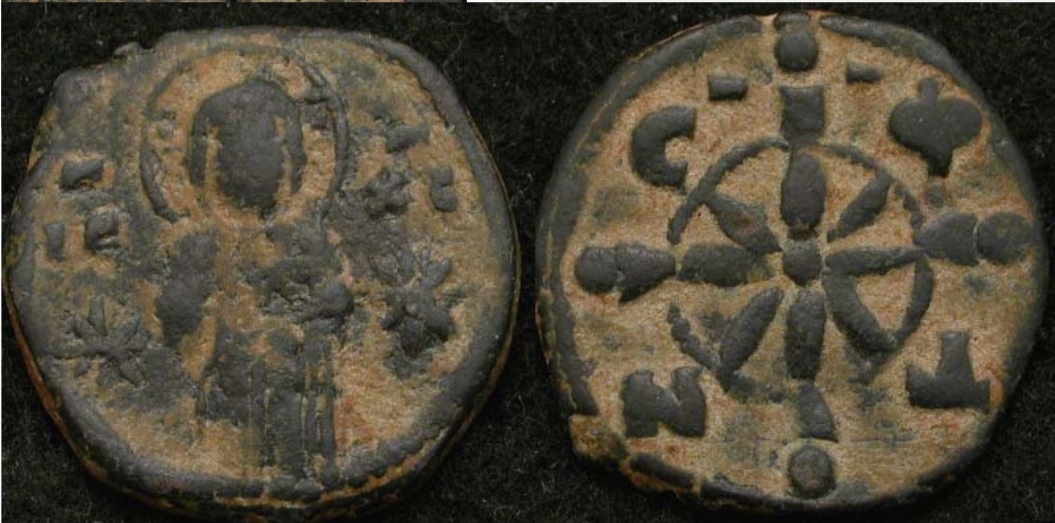
Byzantine, weight 5.5 gm, Obverse: Christ standing facing, IC XC either side, eight-pointed star below, either side, Reverse: C N in quadrants of cross with big dot at each end. Eight-pointed star in circle.


Akbar, AH 963-1014, or AD 1556-1605, copper, Nisfi, weight 10 gm, Obverse: Nisfi in Persian, Reverse: Eight-pointed star.


Troas, Kolone, 4th century BC, weight 1.3 gm, Obverse: Laureate head of Athena, Reverse: Eight- pointed star, grain ear.                                              


Travancore, One Cash, Chithira Thirunal Bala Rama Varma II, 1928- 1949, copper, weight 0.4 gm, Obverse: Eight-pointed star surrounds Shankh (conch shell) at center, Reverse: Legend in Malyalam, ''Oru-Kaashu''.


Tillya Tepe, Afghanistan, Buddhist gold coin 1st century BC-1st century AD, Obverse: Kharosthi legend' ''Dharmaca krapravata'', or the one who ruled the Wheel of the Law, Reverse; Kharosthi legend, Sih(o) vigatsbhay(o), or the lion who dispelled fear. This coin was in the Kabul Museum.


Akbar, 1556-1605 AD, silver rupee, Ahmadabad mint, weight 11.2 gm, Obverse: legend within 4-pointed star, Reverse: legend within eight-pointed star.


Coins: Eight-Pointed Star. 

Friday, December 1, 2023

Naiki Devi, Forgotten Chalukya Warrior Queen who defeated Muhammad Ghori in 1178 AD and Coins


Naiki Devi, a Goan princess was the regent queen of the Chalukya dynasty during her son Mulraja II's infancy from 1175 AD. She was the queen of king Ajayapala, the Chalukya Gujarat king who rose to the throne in 1171 AD, but died in 1175 AD. 


       Chalukyas of Gujarat, Drachm, 11th century 


                     Naiki Devi, the Warrior Queen                     


                   Map of Chalukyas, 1150 AD.
    

Muhammad Ghori (the founder of the Delhi Sultanate in 1206 AD) invaded India and captured Multan in 1175 AD. Soon after, he led a major army to Uch (present day Pakistan) after marching down the Gumal / Gomal Pass. From there, he was able to traverse the desert and begin his journey towards Anhiwara (capital of Chalukya Kingdom). At that time, Gujarat and Rajasthan were part of Chalukya kingdom. Ghori was obviously confident that the Chalukyas were susceptible to invasion since they lacked a monarch. Besides he considered the queen as weak and easy to conquer.  


Naiki Devi remained undaunted about the possibility of an invasion of her kingdom by the marauding forces of Ghori. She decided to throw herself completely into strategizing a well-conceived opposition to the invading hordes. She also opened diplomatic channels seeking support from neighbouring kingdoms for help including to the court of chivalrous Prithviraj Chauhan who held sway over large parts of what is today's Delhi, Haryana, Rajasthan and even parts of Punjab, Uttar Pradesh and Madhya Pradesh. However, unfortunately for reasons best known to them, none of them including Chauhan, seemed to share the foresight of Naina Devi in forging an alliance against the recurring menace. It was left for her to garner the support of the vassal state of the Chalukyas, the clans of the Naddula Chahamanas, the Jalor Chahamanas and the Parmaras. Naiki Devi realised that in terms of size and strength this ragtag confederacy was no match to Ghori's superior army. She had to plan out her strategy that would help her even against the odds that were stacked against her.                          

Quite like her ancestor Bhimdeva I, who had drawn the forces of Sultan Mahmud of Ghazni to a battleground of his choice, Naika Devi planned the conquest against the Ghorid armyin the rugged terrain of Gadaraghatta. This was an area at the foothills of Mount Abu, near the village of Kasahrada (in today's Sirohi district). The narrow hill passes there, and the terrain was completely unfamiliar to the invaders. When the armies of Muhammad Ghori made their way towards Kasahrada, the Queen made a frontal attack on them. 

The Battle of Kasahrada of 1178 AD. At the foot of Mt Abu, the Ghurid army confronted the combined army of Chalukya feudatories, Parmaras of Abu, Chahamana of Nadol and Kirtipal from Jalor. According to Prabandha Kosha, the Ghurid army was led into the pass and closed the enemy retreat behind them. There was a frontal assault by the Chalukya army led by Naiki Devi leading with child Mulraja II who was 13 years old tied to her body. Through her strong combat skills, she cut down every invading soldier that came her way. An outnumbered army managed to crush the forces that had just vanquished the mighty Sultanate of Ghazni and thereafter the mighty Sultans of Multan. 


The unexpected massive rout that befell his army shattered Muhammad Ghori's pride, more so since this defeat was wrought on him by a woman whom he had vastly underestimated. He fled from the battlefield with a handful of bodyguards to save his life. 


Artistic impression of Naiki Devi at the battle of Kasahrada. The Ghori army trapped in the narrow mountain pass in the background.   
 

Such was the rude jolt he received from this battle that he never again returned towards Gujarat and instead eyed Punjab, the following year. Gujarat remained invincible for Muhammad Ghori personally. Had this conquest been won by Ghori, the whole of southern Rajputana and Gujarat would have gone under his control and the history of India might have taken a different course.


Ghurid Empire, from 1175 to 1205 AD, Orange line show the territorial conquests.
   

Naiki Devi's epic victory finds echoes in the works of several local chroniclers.   A Chakukyan inscription from the reign of Bhima II (Mularaja II's brother and successor) states that even a woman could defeat the Hammira during the reign of Bala Mularaja. The Muslim chroniclers too, have unabashedly mentioned the rout that Ghorid forces faced in Gujarat. Minhaj-i-Siraj states that in the Islamic year 574AH, (1178 AD) Mu'ízzud-Din ''marched towards Nahrwala by way of Uchchha and Multan. The Rae of Nahrwala was young in years, but had numerous forces, and when the battle took place, the army of Islam was defeated and put to rout, and the Sultan-i-Ghazi ( Muízzud-Din) returned without accomplishing his designs. The sixteenth century Badauni and later Ferishta wrote about the defeat of Ghori. 


Coins of Gujarat Chalukyas.

The silver Gadhaiya was the coin used in the region ruled by Chalukyas of Gujarat. These coins are attributed to the Indo-Sassanian dynasties and their successors. They were basically a degenerated copy of the Sassanian coinage with an impressionist type bust in front and a rather aspirational version of a fire altar in the reverse.   


Chalukyas of Gujarat, 11th century AD, Drachm, weight 3.7 gm, Obverse: crude Indo-Sasanian style bust right, Reverse: Stylized fire altar.


Gujarat Chalukyas, Silver Drachm, 11th century, Gadhiya Paisa, silver, weight 4.1 gm, Obverse: Degenerated Indo-Sasanian style bust right, sun and moon above, Reverse: Stylized fire altar, sun above left crescent moon above right. 


Chalukyas of Gujarat, Gadhiya paisa, 11th century, silver, weight 4 gm, Obverse: Degenerated Indo-Sasanian style bust right, sun and moon above, Reverse: Stylized fire altar, sun above left crescent moon above right.


Earlier Chalukya coins show a slow degenerated Indo-Sasanian style on both sides, over 500 years, till arriving at the Gadhiya paisa. (5th century to 11th century)


Earlier Chalukya coins show a slow degenerated Indo-Sasanian style on both sides, over 500 years, till arriving at the Gadhiya paisa.


Chalukyas of Gujarat, 1030-1120 AD, silver, weight 4 gm, Obverse: Stylized Sassanian head to right, surmounted by crescent, Reverse: Fire altar, pelleted sun and crescent. 


Chalukyas of Gujarat, 1030-1210 AD, silver, weight 3.8 gm, Obverse: Stylized Sassanian head, Reverse: Fire altar, pelleted sun and crescent. 


Chalukyas of Gujarat, 1120-1210 AD, silver, weight 4 gm, Obverse: Stylized Sassanian head to right, surmounted by crescent, Reverse: Fire altar, pelleted sun and crescent. 


Chalukyas of Gujarat, Kumarapala, 1144 AD, gold pagoda, weight 3.9 gm.

Thursday, November 23, 2023

Marthanda Varma of Travancore: Forgotten King who crushed the Dutch and Coins


After the Turks, the Europeans took the charge of invading our country, this time via sea routes. From the 16th century European powerhouses like Portuguese, French, Spain, British and Dutch started to establish their factories across India. One of them was the Dutch who wanted to control trade of Kerela region. But their dreams were shattered when the young King of Travancore crushed them in the Battle of Colachel in 1741. His name was Marthanda Varma.

Marthanda Varma was the founding monarch of the southern Indian Kingdom of Travancore (previously Venadu) from 1729 (when he was 24 years old), until his death in 1758. He was succeeded by Rama Varma.  He adopted a European mode of discipline for his army and expanded his kingdom northwards, to what became the later State of Travancore. He built an army of 50,000 Nair men and designed a well-organized war machine. His alliance in 1757 with the ruler of Kochi (Cochin) against the northern Kingdom of Calicut, enabled the kingdom of Kochi to survive.


    One Kalyinam Fanam, Marthanda Varma, gold, 

                     
                              Marthanda Varma.

Travancore under Marthanda Varma made a deliberate attempt to consolidate its power by the use of Indian Ocean Trade. There was European monopoly in Indian Ocean spice trade. The constant Dutch blockade of Malabar Coast was very normal. He wanted to change this system. 


               A map of Malabar Coast in 1733.


Marthanda Varma's reign was one of constant warfare, against opponents both inside and outside is territory.  He realized that Dutch power in Kerala stemmed from their flourishing spice trade at the port of Kochi. He set out to conquer the major spice producing areas supplying cargo to Kochi. 


The logo of the Amsterdam Chamber of The Dutch East India Company

During a visit to Cochin in 1739, the Dutch Governor of Ceylon, Gustaff Willem Van, made an attempt to discuss and offer his terms to Varma to put an end to his expansionist policy including the Malabar Kingdoms. But Marthanda Varma refused to agree on any terms, which was a trigger to the Battle of Colachel in 1741.

In 1741, a Dutch artillery force landed at Colachel from Ceylon and captured up to Kottar and advanced against Kakulam, Travancore's capital supported by strong artillery. In the following battle, the Travancore forces won a resounding victory over the Dutch and resulted in total carnage for the invader. 

This was the first time a major European power was decisively defeated in Asia. 

The enemy surrendered on August 14, 1741. It is also believed that the Dutch never recovered from this defeat and the empire soon started declining after it. 


Eustachius De Lannoy surrendering to Raja Marthanda Varma at the battle of Colachel, August 1741


Victory Pillar, in remembrance of the victory against the Dutch in 1741, near the coast of Colachel.


De Lannoy, a Captain, who was captured in the battle subsequently earned the trust of the king, who made him an officer in the Travancore military. He later trained the Travancore Army and in due course of time became a valiant and successful commander of the same army that had defeated the Dutch forces. He modernized the army by introducing firearms and artillery.  After declaring a state monopoly on pepper in Travancore in 1743, between then and 1752, the king annexed Quilon, Kayamkulam, Thekkumkur and Purakkad to Travancore, thereby delivering a serious blow to the commerce of the Dutch. Eventually, Travancore challenged and broke the Dutch blockade of the Kerala coast.


De Lannoy's Tomb at Udayagiri Fort, on Kanyakumari-Trivandrum highway.

Travancore became a prominent city in Kerala under Marthanda Varma. He undertook many developments during his reign. In January 1750, he decided to ''donate'' his kingdom to the last Tiruvadi Sri Padmanabha (family deity) and rule as the deity's ''vice-regent''. His policies were continued in a large measure by his successor Rama Varma.


Padmanabhaswamy Temple, Thiruvananthapuram

Coins of Marthanda Varma


Thirunal Marthanda Varma, gold Kaliyan, weight 0.4 gm, Dia 9 mm, Obverse: stylized depiction of Vishnupadam (feet of Lord Vishnu), Reverse: 12 pellets (signifying the 12 zodiac signs), lines and a dot below.


Thirunal Marthanda Varma, One Chuckram, silver, weight 0.3 gm, Dia 7mm, Obverse: Crescent with diamond above and two curved lines and ten pellets below, the curved lines and pellets are a depiction of Vishnupadam (fleet of Lord Vishnu,), Reverse: 12 pellets above a crescent representing the Rashi (12 signs of the zodiac). 


Marthanda Varma, Silver Veli Chukram (5 coins), 1729-1758 AD, Obverse: Large crescent above Vaishnavee symbol, Reverse: Twelve pellets within curve.


Marthanda Varma, Chukram, silver, weight 0.3 gm, Dia 6.2 mm, Obverse: stylized depiction of Vishnupadam, Reverse:  dots above a crescent visible.


Marthanda Varma, 1729-1758 AD, Chuckram, weight 0.3 gm, Dia 6.3 mm, Obverse: Crescent with diamond above and two curved lines and ten pellets below (depiction of Vishnupadam, feet of Lord Vishnu, Reverse: 12 pellets above a crescent representing the 12 signs of zodiac. 


Marthanda Varma, One Kaliyan Fanam, gold, weight 0.3 gm, Dia 8 mm, Obverse: Crescent with diamond, flanked by two beads above and two curved lines with ten pellets below (signifying toes), Reverse: 12 pellets (depicting zodiac signs), lines and a dot below.


Two Fanams, gold, weight 0.3 gm, a coin issued in 1758, the year Rama Varma took over, Obverse: Design evolved from Kaliyan Fanam, large crescent above Vishnu Padam (feet of Lord Vishnu) represented by two curved lines and 10 pellets for toes, Reverse: 12 pellets considered to represent 12 Rashis (zodiac signs), lines and dots below.


9 Madras (Travancore), Tri-centenary celebrations postage stamp depicting the Battle and the victory pillar.  
                         
   
Marthanda Varma

Rome vs Persia, 260 AD.

  In 260 AD, the unthinkable happened. The Roman Emperor Valerian I was captured alive by the Sasanian Emperor Shapur I, following the Battl...