Sunday, November 13, 2022

Roman Coin with an Astronomical mystery discovered off Israel's coast


Israeli Antiquities Authority's Marine Archaeology Unit recently found a rare, 1877-year-old bronze coin with the Roman Moon Goddess Luna above a depiction of the zodiac sign Cancer (a crab). The coin was found off the Carmel Beach in Haifa. On the other side of the coin is the head of Roman Emperor Antoninus Pius (131-161 AD) during whose reign it was minted.   In ancient Roman mythology, Luna is the deity representing the moon and she is best known for wearing a crescent as a crown and riding her chariot as she casts the darkness of the night. She is the female counterpart of her brother Sol, the personification of the sun.


Rare bronze coin depicting Cancer the crab beneath the moon goddess Luna

Unit director Jacob Sharvit said, it was the first time such a coin has been found off Israel's coast, and this coin was found among a small hoard of other coins probably from a shipwreck. The coin was minted in Alexandria, Egypt, and is dated ''year eight'', or the eight year of Antoninus Pius's rule, or 144/145 AD. Pius's reign was well remembered, and historians note him as one of the ''Five Good Emperors'' alongside Nerva, Trajan, Hadrian and Marcus Aurelius.                        

The Rare bronze coin depicting Cancer, the crab sign below goddess Luna on one side and Emperor Titus Aelius Hadrianus Antoninus Pius on the other side, bearing the date ''Year eight'' i.e. 144/145 AD

The coin in particular is no exception, with the writing telling us exactly when and where the coin was minted, but the interesting depiction on the coin sent the astronomical community into interesting research. This coin would have been part of a set of twelve, depicting the houses of the zodiac. David Dickinson, in an article published in ''Universe Today", Courtenay, BC, writes that he did begin to wonder if this depicted a real astronomical event, visible from the Mediterranean region in the times when the coin was minted. As no bright star exists in Cancer, he suspected it was actually a bright planet, say, Jupiter or Venus. He used the ''Occult 4.2 program'' and the planetarium program ''Stellarium'' (which takes into account the -26,000-year precession of the equinoxes and stellar proper motion over the centuries) and found one event that was specially intriguing: the dusk conjunction of the waxing crescent Moon and Jupiter on the evening of June 4th, 140 AD, in the sign of Cancer.
                         
Dusk looking west from the Mediterranean region on the evening of June 4th, 140 AD: Credit Stellarium
 

Not only did this occur in the reign of Antoninus Pius, but it would have been visible right before the death of his beloved wife Faustina the elder in 140 AD.  Perhaps the ancient coin commemorates her passing. Certainly, there is record of Pius's devotion to Faustina, and his subsequent campaign to deify her after death.                        

The Moon occults Jupiter, June 4th, 140 AD, Credit: Occult 4.2

Modern Astronomy has its roots in the archaic practice of astrology. Ancients watched the sky, noted what they saw and corelated them with actual events. There are many such examples. We remember the astrologer's admonition to Julius Caesar to beware the Ides of March (15th of March), the day he was brutally murdered. Under one possible scenario, a court astrologer could have assigned significance to the conjunction of Jupiter with the moon in Cancer, a portent that later moved a grieving Pius to commemorate the death of his wife, casting her as the Moon goddess Selene.                       

The base of column of Antoninus Pius in Rome, depicting Pius and Faustina, Credit: Saiko/Wikimedia Commons 
    

There was another interesting possibility for the mystery star. As per John Flannery, it could have been Halley's comet of 141AD. He ran a simulation using data from NASA/JPL/Horizons, and 1P/Halley would have been at Right Ascension 9 hours, 13' 12' Declination+ 24 degrees 10' on April 28th, 141 AD in the adjacent constellation of Leo, the Lion shinning at +1st magnitude while the Moon was in Cancer at dusk.                          

Halley's Comet in late April, 141 AD, Credit: Stellarium
 

In astrology, the Moon rules the sign of Cancer. We may never be very sure what the coin intended to depict, but such depictions on coins are important to try and pinpoint the dates and events of the past   


Antoninus Pius

Universe Today


Thursday, November 10, 2022

Aksumite Kingdom Coins


The Kingdom of Aksum, also known as the Kingdom of Axum or the Aksumite Empire, was centered in Northeast Africa and South Arabia from Classical antiquity (8th century BC to 6th century AD) to the Early Middle Ages (6th to the 10th century AD). The empire was based in present day Ethiopia, spanning Eritrea, northern Djibouti, and eastern Sudan and southern Arabia. Axum served as the kingdom's capital till the 9th century AD. The kingdom was one of ancient world's great powers of the 3rd century AD. 


Aksum, King Ousanas, 315-325 AD, gold coin

                        
Aksumite empire's maximum extent of influence, based on p 97 of The Complete History of the World.
 

Aksumites traded with Egypt, Rome, Persia and India. Many of the twenty or so Aksumite rulers are known only from their coins. From the late third century AD, the kings of Aksum minted gold, silver and bronze coins. These were the only coins in Africa, south of the Sahara in ancient times. Artistically, the peak of coinage came under Wazeba and Ousanas (320 AD), who may have been co-rulers. With the reign of Ezana (330-356 AD), Aksum entered a new era. He was the last pagan ruler. His conversion to Christianity was reflected in his coins. The Christian cross symbol was probably used for the first time on his coins. 


      The Obelisk of Axum
 

A large portion of the gold coinage was struck during the time of King Nezana and Nezool, around 460 AD. The empire reached its greatest power under Kaleb around 520 AD, who began a custom of royal names from the Old Testament.

The kingdom's slow decline began in the 7th century and currency ceased to be minted. The Persian, and later Muslim presence in the Red Sea caused Aksum to suffer economically and the population in the city shrank. The kingdom collapsed around 960 AD and Ethiopia remained isolated throughout the Middle Ages (6th to 15th century AD). The history of Aksum was largely forgotten and replaced by myths created by later dynasties.  


Coins of Aksum


Aksum, King Noe, 400-425 AD, gold, weight 1.5 gm, Obverse: Crowned bust facing right surrounded by wheat grains and legend, Reverse: Capped bust facing right surrounded by wheat grains and legend


Aksum, King Ousanas, 315- 325 AD, gold, weight 2.5 gm, Obverse: Crowned bust of Ousanas to right, holding spear in right hand, flanked by wheat stalks, surrounded by lettering, disc on crescent above, Reverse: Bust of Ousanas to right, wearing headcloth, holding whisk in right hand, flanked by wheat stalks, surrounded by lettering, disc on crescent above


Aksum, 340-425 AD, bronze, weight 0.9 gm, Obverse: Bust right, draped, wearing head cloth ornamented on front, within circle, Reverse: Cross within circle, script Greek


Aksum, King Joel, large cross, 590-615 AD, bronze, weight 1.0 gm, Obverse: Draped bust right, wearing crown ornamented with a cross, small pellet behind, Reverse: Greek cross, legend quartered, translation: joel


Aksum, King Joel, 590-600 AD, weight 0.9 gm, Obverse: King Joel around crowned and draped bust facing, cross within crown, Reverse: Cross surrounded by legend ''Christ is wit us''


Aksumite Kingdom

Coinage of Aksum 
 

Wednesday, November 9, 2022

Cornucopia and Coins


Cornucopia is a well-known, and, on coins, often recurring symbol of abundance, fecundity, fertility and happiness. Derived from the latin ''cornu'' meaning ''horn'' and ''copiae'' meaning ''plenty'', it has long been used as a common harvest symbol. It is identified by some with the horn of Amalthea, the nurse of Jupiter, and from which horn fruits and flowers and all the riches of nature and art are represented. Others say that it is the horn which Hercules tore from the head of Archelous, in his encounter with that protean monster, and which the nymphs picked up and converted into the horn of plenty.


Ptolemaic Egypt, Arsinoe II, Philadelphus, 270-268 BC, AR Decadrachm.

Cornucopia, filled with fruits, or enclosed within a wreath, formed of corn-ears and flowers, appear either as a symbol of the monetary triumvirs, denoting the abundance of all the things, to be supplied by means of money, or as the symbol of the curule aediles.

Cornucopia appears in the fifth century BC, as an attribute of the god Hades. The ruler is represented with this object many times on vases of that time. From the fourth century BC, in the reliefs of Asclepeion Athens, Tyche is represented holding a cornucopia. This type of representation develops strongly in the Hellenistic period and then in Roman times. This ornament appears on a variety of antique monuments, both sculptural and numismatics. The cornucopia became the attribute of several Greek and Roman deities.                       

Allegory of Fortune (1658) by Salvator Rosa, representing Fortuna, the Goddess of luck, with the horn of plenty     


Statue of a Ptolemaic queen, perhaps Cleopatra VII, 200-30 BC, dolomitic limestone                 


The cornucopia was one of the most popular religious symbols of the ancient world and was commonly used on Jewish coins. Coins of the Ptolemaic Kings of Egypt, Seleucid Kings of Syria and a number of ancient Hellenistic city-states depicted cornucopia 


Statue of Fortuna, Roman copy after a Greek original from the 4th century BC
  
                     
The interior of a cup discovered in Etruria, dated from 450-400 BC


In Roman coinage, many gods and personifications are represented holding the cornucopia. Abundantia, Africa, Asia, Aeternitas, Moneta, Annona, Ceres, Concordia, Fecunditas, Felicitas, Fortuna, Roma, Salus etc. It usually appears in two positions, either with the mouth or opening facing upwards or facing downwards, depending on the deity being portrayed.

In modern depictions, it is a hollow, horn shaped wicker basket filled with various kinds of festive fruit and vegetables. In Nort America it is associated with Thanksgiving and the harvest. The symbol is depicted in the flag and state seal of Idaho, the Coat of Arms of Colombia, Panama, Peru and Venezuela and the Coat of Arms of the state of Victoria and Australia.


      Coat of Arms of Columbia


      Coat of Arms of Peru


      Coat of arms of Kharkiv, Ukraine


Cornucopia on Coins


Ptolemy VII Euegetes, 145-116 BC, gold, 27.6 gm, Obverse: Diademed and veiled head of Arsinoe II to right, Reverse: Double cornucopia filled with fruit and bound with fillets
                      
Ptolemaic Egypt, Arsinoe II, Philadelphus, 270-268 BC, AR Decadrachm, weight 35.5 gm, Obverse: veiled head of Arsinoe II right, wearing diademed stephane and horn of Ammon, scepter surmounted by lotus over left shoulder, dotted border, Reverse: Double cornucopia bounded by fillet, containing pyramid cakes, pomegranates and other fruits, with grapes cluster, dotted border


Seleucid Empire, Alexander II Zabinas, 128-122 BC, AR Drachm, weight 3.7 gm, Obverse: Diademed head right, Reverse: Filleted double cornucopia


Judaea, Hasmoneans, Alexander Jannaios, 103-76 BC, Prutah, weight 1.9 gm, Jerusalem mint, Obverse: legend in four lines within wreath/splayed double cornucopia with pomegranate between   


Aquilia Severa, Augusta, 220-221 AD, AR Denarius, Rome mint, struck under Elagabalus, Obverse: Draped bust right, Reverse: Concordia standing left, holding double cornucopia and sacrificing out of patera over lighted altar to left, star to right


Bactria, Indo Greek, Philoxenos Aniketos, 125-110 BC, weight 8.3 gm, Obverse: Tyche standing left, raising right hand and holding cornucopia, monogram to lower left, Obverse: Zebu standing right 


Kushan Empire, 325-345 AD, Dinar, gold, weight 7.9 gm, Obverse: Shaka standing left, sacrificing over altar and holding staff, trident to left, ''bhri'' in Brahmi below arm, Saka in Brahmi outer right, Reverse: Ardoxsho enthroned facing, holding diadem in right hand and cradling cornucopia in left arm, tamgha,  upper left, Vasudeva II 


Judaea, Hasmonean Kingdom, Mattatayah, 40-37 BC, AE Prutot, weight 14.4 gm, Jerusalem, Obverse: Mattatayah and council of the Jews, double cornucopia, Reverse: Ivy wrath tied with ribbons


Sunday, November 6, 2022

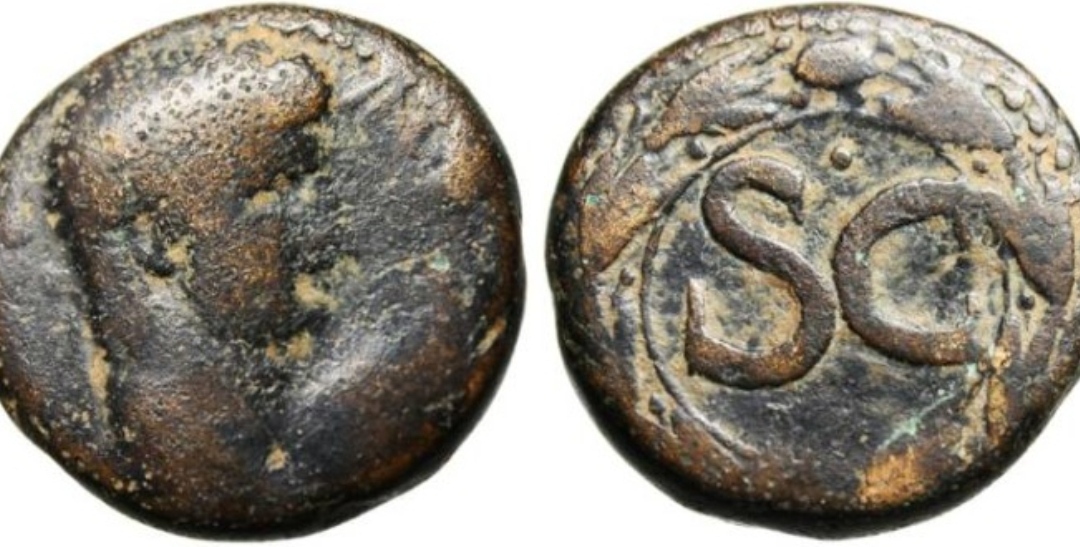
Senatus Consulto (S.C.) Roman Coins


The Senate was a political Institution in the ancient Roman Kingdom. The Senate is said to be created by Rome's first king, Romulus, (753-716 BC) initially consisting of 100 men. The Senate held three principal responsibilities. It functioned as the ultimate repository for the executive power, it served as the king's council, and it functioned as a legislative body in concert with the people of Rome. During the years of monarchy, the Senate's most important function was to elect new kings. While the king was normally elected by the people, it was actually the Senate who chose each new king.

When the Republic began, the Senate consisted of 300-500 senators who served for life. The Senate of the Roman Republic passed decrees called ''Senatus Consulta'', which inform constituted ''advice'' from the senate to a magistrate. These decrees usually were obeyed in practice. The first emperor, Augustus (27 BC-14AD), reduced the size of the Senate to about 100 to 200 active seniors at one time, out of a total of about 600 total senators. 

What exactly does the Senate have to do with coins. The SC also appears on base metal coins of Antioch and Cyprus, far away from the purview of the Senate. It also continues long past the time when the senate itself and its decrees had any relevance. When these letters EX. S.C are found on Roman coins, they signify, not that the Senate caused them to be struck, but the coinage of them had the ''Senatus Consultum'' or senatorial sanction when struck. EX. S.C appears on many family coins, but in the Imperial series, the mark is observed on coins of Augustus, Agrippa, Claudius, Nero, Vespasian, Titus, Faustina, Marciana, Hadrian, and Sept Severus. 


These base metal coins inscribed with S.C. contained messages for the public, as these coins had the widest reach and the best possibility of making an impact. For most ordinary Romans, this is what coinage was, and the message it sent was simple, the existence and importance of ''senate consultum'' (the text emanating from the senate) and the Senate in general. The ordinary Roman could look at one of these coins and see that Senate still existed and still mattered. 


Coins with S.C                            

Augustus, Rome Mint 16 BC, weight 9.9 g, Obverse: CAESAR AVGVSTVS, bare head of Augustus facing right, Reverse: C CASSIVS CELER around S.C.     


Tiberius, Rome Mint, 21-22 AD, weight 9.8 g, Obverse: TI CAESAR DIVI, bare head of Tiberius facing left, Reverse: PONTIF MAXIM TRIBVN, around S.C.

                            
Claudius, Antioch mint, 41-54 AD, weight 15 g, Obverse: IM TI CLA CAE, laureate head facing right, Reverse: Large SC within wreath  


Ostrogoths Theodahad, 534-536 AD, follis, Rome mint weight 12.1g, Obverse: D N THEEO DAHATVS REX, mustached and mantled bust right, wearing ornate decorated with pectoral cross, Reverse: VICTORIA PRINCIPVM, SC across field, Victory standing right, holding palm across left shoulder and wreath in right hand 


Senatus Consulto (S.C.)

S.C on Roman Coins
             

Friday, November 4, 2022

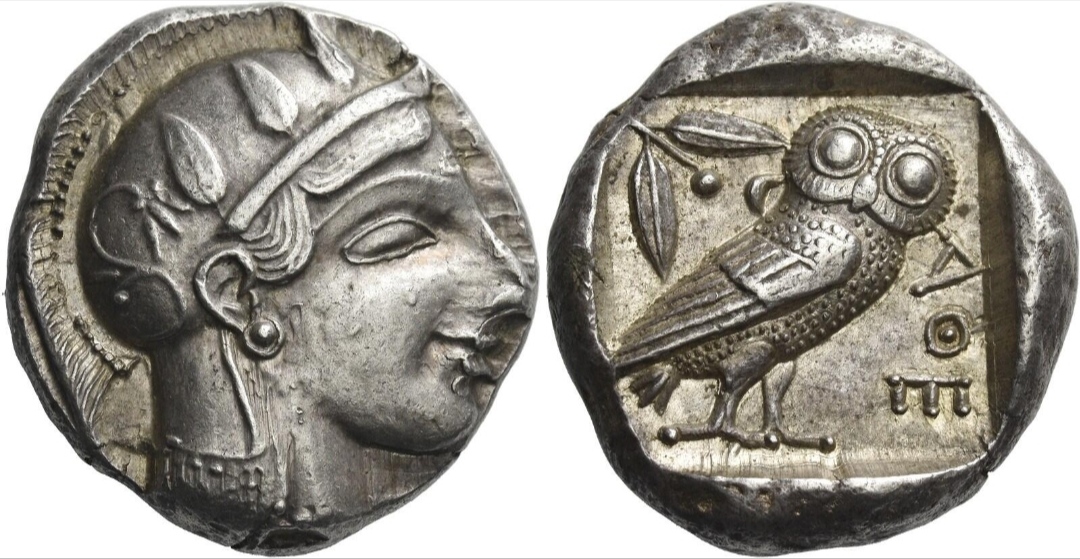
The famous Athenian Owl Tetradrachm Coin (5th century BCE)


The Owl of Athena was one of the most important symbols in ancient Greece. It became a political, literary and philosophical symbol. Athena was a virgin warrior goddess and was widely worshipped in the Greek world. The goddess was the embodiment of wisdom, strategy, warfare and technical skills. Athena was long associated with the owl. Some believe it was inherited from the Indo-Europeans or Minoans (2000-1500 BCE). Owls are intelligent birds and highly effective hunters. These qualities are those that represent many of the aspects of Athena. There were many depictions of Athena with her companion, the owl. According to the myth, the owl sat on the blind side of the goddess and allowed her to see everything and to comprehend the truth.                        

Athens Greece Silver Tetradrachm, 440 BCE

Some believe that the name of the greatest Greek city Athens came from the goddess. 


Athena holding a helmet and a spear, with an owl (490-480 BC), The Metropolitan Museum of Art.


Mattei Athena at Louvre. Roman copy from the 1st century BC after a Greek original of the 4th century BC
           

The owl became a symbol of the city. Many Athenian coins have the symbol of Athena and the owl. 

The Romans were deeply influenced by Greek religion and myth. One of Rome's most important deities was Minerva, the Latin Goddess of reason, wisdom, strategy, poetry and handicraft became associated with Athena. The Romans adopted the Owl of Athena to represent the powers and characteristics of Minerva. Like her Greek counterpart, the Roman deity came to be represented by the symbol of the nocturnal raptor in art and coins.


Fresco of the Roman goddess Minerva
 

The owl of Athena became the common obverse of the Athenian tetradrachms after 510BC and according to Philochorus (Greek historian of the third century BC), the Athenian tetradrachm was known as ''glaux'' (little owl) throughout the ancient world and ''owl'' in present day numismatics.


Raised relief image of Minerva on a Roman gilt silver bowl, 1st century BCE
 

Aristotle used the symbol of the owl to denote the wise. The 19th century German idealist philosopher Hegel famously wrote that ''the owl of Minerva spreads its wings only with the falling of the dusk''. This refers to the fact that people only become wise after the event has passed. Philosophy appears only in the ''maturity of reality'', because it understands in hindsight.  

The owl is still a symbol of wisdom to this day. Today being as ''wise as an owl'' is a popular expression.  


Athens Tetradrachm, 465 BCE, silver, weight 17.15 g, Obverse: Head of Athena wearing crested Attic helmet decorated with spiral palmette and three olive leaves, Reverse: AOL Owl standing with closed wings, head facing, behind olive sprig with one berry and crescent. All within incuse square.
 

The thick and heavy Athenian owl tetradrachm was the largest silver coin of its time. These were produced for over four hundred years. While the art style changed, the theme remained consistent, showing Athena, on the obverse and an owl on the reverse. Mintage of these coins started around 512 BCE and continued through the early fifth century BCE. In 449 BCE, the designs were revised, and production increased. These later coins are more common than the earlier issues. The value of a tetradrachm was too high for daily transactions, but was used for building projects, trade and payment for war preparations.

The inscription ''AOE'' is an abbreviation of AOENAION, ''of the Athenians''. These coins were copied by other countries too. The reverse features an olive sprig, referring to olive oil, one of Athens' primary exports. A crescent shape, possibly a waning moon is depicted on most issues. Athena's profile is depicted with an enigmatic smile, with a floral design on her helmet. New style tetradrachms were minted in the second century BCE. 


Athena Owl

Athena Owl Tetradrachm Coin

Wednesday, May 18, 2022

Pratapgarh State (1425-1947) and Coins


Pratapgarh State also known as 'Partabgarg' was one of the princely states during the British Raj. The state was founded in 1425 as Kanthal state and was later renamed after its capital located in Pratapgarh, Rajasthan. It was situated in the south-eastern part of Rajasthan.


Pratapgarh, 1/2 Rupee, Sawant Singh, 1785


Pratapgarh State in the Imperial Gazetteer of India


Maharana Kumbha ruled Chittorgarh in the 14th century. Due to a dispute with his younger brother Kshemkarn, he expelled him from his territory. Kshemkarn's family was refugee for some time and lived in the Aravalli Range in the southern area of Rajasthan. In 1425 Kanthal state was founded. In 1514, Rajkumar Surajmal became the ruler of Devgarh, and this raj later came to be known as Pratapgarh. As the environment of Devgarh was not found suitable by the Royal family, one of the descendants of Raja Surajmal, Rajkumar Pratap Singh started to build a new town near Devgarh and named it Pratapgarh.

Flag


Coat of Arms


The rulers had a title, ''Rawat'', till the 9th ruler, who was Rawat Jashwant Singh. The 10th ruler, Maharawat Hari Singh, was given the title of ''Maharawat'' by the Mughal Emperor.  


        Old Palace, Pratapgarh

They had a right to a 15 gun salute. The 22nd ruler, HH Maharawat Sir Ram Singh II Bahadur, signed the accession to the Indian Union.

Coins of Pratapgarh


Pratapgarh, One Paisa, Uday Singh, 1886, copper, weight 7.8 gm, Obverse: Rayed oval face of sun god Surya , Reverse: Riyasat Pratapgarh      


Pratapgarh, One Paisa, Raghunath Singh, 1883-1896, copper, weight 7.5 gm, Obverse: Floral design, legend ''Samvat'', date VS 1953, Reverse: ''Shri/Raj Dev /gadh Prata-/ pgadh''


Pratapgarh, 1/4 Rupee, Shah Alam II, Dulep Singh, 1821, silver, weight 2.6 gm, Obverse: Inscription, Shah Alam II, Reverse: RY 45.


Pratapgarh, 1/2 Rupee, Sawant Singh, 1785, silver, weight 5.3 gm, Obverse: RY 29, Reverse: Shah Alam, AH 1199


Pratapgarh, One Rupee, Shah Alam II, Sawant Singh, 1771-1785, silver, weight 11.9 gm, Obverse: Shah Alam II, AH, date 1197, Reverse: Manus maimanat sanah julus zarb devgarh     


Pratapgarh, 1/8 Rupee, Shah Alam II, 1821, silver, weight 1.4 gm, Obverse: Shah Alam II,                


Pratapgarh, One Rupee, Dulep Singh, 1821, silver, weight 10.9 gm, Obverse: AH 1236, Reverse: RY 45


Pratapgarh State

Pratapgarh State Coins
                                               

Rome vs Persia, 260 AD.

  In 260 AD, the unthinkable happened. The Roman Emperor Valerian I was captured alive by the Sasanian Emperor Shapur I, following the Battl...