Tuesday, April 12, 2022

Wire Money of Russia


Wire Money of Russia was produced as early as the 14th century and issuance continued into the beginning of the 18th century. It was issued in both denga and kopek denominations, depending on the time period when a particular coin was issued.


Ivan IV, Russian Wire Money, Dengas, 1533-1547 AD

The coins were struck by taking a piece of silver wire, cutting it to the proper weight, then smashing it between a pair of dies by  strong-armed Russians. The coins are usually struck partly off center. Many examples show a horseman on one side and legends on the other. Detailed English language information on them is scarce and much of the information is in Russian 


Kopeks of Tsar Michael, all weigh just over 10 gm of silver, just over a week's wages in early 17th century
   

By the time of the 13th century Mongol invasion, lands that would eventually become Russia were fragmented and isolated. This fragmentation and isolation brought about a coinless period lasting two centuries. Standard tools of barter, like beads and squirrel furs, took the place of coins. Large amounts were stored in precious metal bars, known as ''grivna''. Silver grivna weights were eventually standardized within each principality. ''Kyivian'' were about 150 gm and Novogord were 204 gm, about equal in value to 500 squirrel pelts. A modified version of the word ''grivna'' is, today the unit of currency of Ukraine, the hryvnia.

The Tatar Mongol overlords of the Golden Horde minted coins by taking silver wire, cutting it, and hammered it flat. Moscow under Dmitry of the Don in the 1360s, started to do the same. The wire was measured out in fractions of grivna, so coin weights were standardized. Even when, in the late 15th century, Dmirty's grandson, Ivan III, threw off the Tatar yoke and united the Russian lands into a single country, different places continued using different weights and designs.

Ivan III's grandson , Ivan IV, inherited the throne in 1533 at the age of three. Almost immediately, his mother and regent, Elena Glinskaya reformed currency. Coins weighing 0.68 gm were called ''kopeks''. Almost all these coins had text on one side and a horse and rider with a spear pointing towards the lower right on the other


                       Kopek of Ivan IV
 

A half kopek, closer to the weight of coins in Moscow, was called a ''denga'', the plural of which ''dengi'' remains to this day the Russian word for money. Ivan IV was later known as Ivan the Terrible.  


                       Denga of Ivan IV

Following the death of Ivan the Terrible in 1584, Russia fell into a period of chaos and civil war. In a effort to bring an end to the fighting, in 1613 the Council of All Russia elected the 16-year old Michael as Czar. Though many expected him to fail, the young Michael slowly established his control over Russia and wisely avoided involvement in the wars of Europe. By the time of his death in 1645 he had established the powerful Romanov dynasty. Wire money is crudely produced, and extremely small. The coins weigh between 0.17 to 0.70 gm during different periods and different rulers. 


Kopek of Peter the Great, 1672-1725 AD, photo and complete design


Ivan the Terrible, 1533-1547 AD, AR Denga, silver, weight 0.34 gm


Ivan the Terrible, 1533-1547 AD, AR Denga, silver, weight 0.33 gm


       Kopek, Peter the Great, 1672-1725 AD


                    Kopek, Peter the Great


The market of these coins, is in the lands they were circulated. Identifying them especially from just part of its design is a challenge though. The standard guide for wire coins from Ivan the Terrible to Peter the Great is ''Kleshchinov and Grishin's, four volume Catalogue of Medieval Coins of Russia''.  


Wire Money of Russia

Kopek

Denga

Friday, April 8, 2022

Dungarpur Princely State (1197-1947) and Coins


Dungarpur State was a princely state during the British Raj. Its capital was the city of Dungarpur in the southernmost part of the present day Rajasthan State. Dungarpur is the seat of elder branch of Sisodiyas of Udaipur, while the younger branch is the seat of the Maharana of Mewar.


       1/2 Mohur, Lakshman Singh, 1943, gold,


Dungarpur State was founded in 1197 by Samant Singh, the eldest son of the ruler of Mewar, Karan Singh. They are descendants of Bappa Rawal, eighth ruler of the Guhilot Dynasty and founder of the Mewar dynasty (734-753). The chiefs of the state bear the title of Maharawal. The town of Dungarpur, the capital of the state, was founded towards the end of the 14th century by Rawal Bir Singh, who named it after Dungaria, an independent Bhil chieftain. 

Flag


Dungarpur State in the Imperial Gazetter of India


After the death of Rawal Udai Singh at the Battle of Khanwa in 1527, where he fought alongside Rana Sanga against Babar, his territories were divided into the states of Dungarpur and Banswara. It remained under Mughal, Maratha and British rule (control by the treaty in 1818), where it remained 15-gun salute state. The revenue of the state was Rs 2,00,000 in 1901.


View of the Juna Mahal Palace of Dungarpur

The last princely ruler of Dungarpur was HH Rai-i-Rayan Maharawal Shri Lakshman Singh Bahadur (1918-1989), who was awarded Knight Commander (KCSI) in 1935 and Knight Grand Commander (GCIE) in 1947, and after Independence became a Member of the Rajya Sabha twice, in 1952 and 1958, and later a member of Rajasthan Legislative Assembly (MLA) in 1962 and 1989.  


HH Rai-i-Rayan Maharawal Sir Lakshman Singh Bahadur

Coins of Dungarpur


One Paisa, Lakshman Singh, 1944, copper, Obverse: Coat of Arms, Reverse: Value and date


One Paisa, Lakshman Singh, 1944, copper, Obverse: Coat of Arms, Reverse: Value and date


1/2 Mohur, Lakshman Singh, 1943, gold, weight 5.4 gm, Obverse: Lettering Raja Dungarapura, Reverse: Dagger, lettering, san 2000


One  Mohur, Lakshman Singh, 1943, gold, weight 10.8 gm, Obverse: Lettering Raja Dungarapura, Reverse: Dagger, lettering, san 2000

                                             
One Paisa, Udai Singh, 1860, copper, weight 9.5 gm, Obverse: Dagger points right, Reverse: Inscription in Nagari 


Dungarpur Princely State

Dungarpur State Coins


Saturday, April 2, 2022

Rarest and Most Valuable Stamps of India


The rarest and most valuable Indian stamps that have realized very high prices at International Philately auctions across the world.                                     


10 Rupees Gandhi Stamp 1948 with SERVICE overprinted. In August 1948, India celebrated the first anniversary of its independence. To commemorate this historical event, the Indian Postal Service launched a special 10 rupees stamp depicting Mahatma Gandhi. Only 200 specimens of 10 Rupee Gandhi stamps were overprinted with ''SERVICE'' and issued for the use of Governor-General of India, making it the world's least printed philatelic issue. Only 18 examples are known in existence today.                                       


In September 2013 unmounted mint example of this collectible fetched a price of 168,000 EUR or roughly $200,689 at David Feldman auction.                                     

A strip of four rare 10 rupees Gandhi stamps was sold for 500,000 UK Pounds at Stanley Gibbons auction in April 2017.


Inverted Head 4 Annas stamp, 1854. It was one of the first multicoloured varieties in the world issued in 1854. The stamp is  special because of the error, the head of Queen Victoria was printed upside down on exactly 206,040 copies. The mistake was discovered in 1890 and only 28 examples are known to exist today. This stamp is regarded as the legendary and greatest of Indian classic rarities                                   

A specimen of this item was sold for $170,500 at Spink in October 2010 from the Medina Collections. 


Duttia 1/2 a black on blue green stamp, 1896. This is one of the most interesting stamp of Duttia's first issue. The stamp is imperforate, without gum, and hand-stamped with a circular, control in blue. Philatelists estimate that only five specimens of this rare collectible, of which one is affixed to piece and cut into, and another defective, are available today. The finest of these samples appeared at the Stanley Gibbons auction in May 2021 and was sold for 58,000 UK Pounds or roughly $80,701.


Four Annas Second Printing Stamp, 1854. This is one of the country's first issues, with a simple design showing the bust of Queen Victoria, the country's name ''India'' and the denomination in words ''four annas''. The stamps were printed locally and issued imperforate. While all these stamps are not rare, some specifications such as different dies and printing methods make some unique. One particular stamp showing blue dividing lines with a part of the bottom margin imprint of the office in Calcutta, coming from the second of three dies used, and the frame from the first was sold for $51,200 at Spink auction in September, 2016 in Singapore.                                      

A rare pair from the fourth printing, with considerable original gum sold for $44,100. 


1/2a Blue Scinde Dawk stamp, 1852.  Issued on July 1, 1852, these stamps were so fragile that they easily cracked and disintegrated. As they were often used as a seal, many were destroyed after the letters were opened. The red stamps were issued first, the blue later. These stamps are found in several shades of blue. Shortly after their release, the Scinde Dawks were withdrawn from use. A very rare unused example was sold for $28,342 by David Feldman on May 19, 2011. Another stamp without gum realized $16,057 at Siegel auction in December 2018.


1/2a Scarlet Scinde Dawk stamp, 1852. The first stamp to be issued in Asia. Because it was embossed on the wafer, the stamp was very fragile and had a tendency to crack. Although these stamps were quite common and widely used at that time, less than 100 are now known to exist, giving it a status of exceedingly rare . This stamp was sold for $27,000 at HR Harmer auction in June 2016. Another stamp on the part cover, with usual cracks and minor marginal chippings, was sold for $18,520 at Christoph Gartner auction in June 2016.


2a Violet Official Provisional stamp, 1866. These improvised stamps were made by taking ''Foreign Bill'' revenues, cutting off to the top and bottom inscriptions, and overprinting the stamps ''Service Postage''. The design consisted of the usual Victoria profile. The used example of the 2a with inscription was sold for $19,000 at Spink auction in October 2010.


King George V, One and a half annas definitive with a watermark, 1929. This stamp with a sideways watermark is a unique variety of India's definitive stamp. One of the assumption says that the stamps may have been produced when a corner of the sheet was accidentally folded over at exactly 45 degree angle during printing. The other reason could be that a hole in the unprinted sheet could have been patched with a slip of stamp paper rotated 90 degrees. A definitive with a sideways watermark was auctioned for $16,750 by Christoph Gaertner in October 2016.


King George V, 1R error stamp, 1926. This stamp with an error does not show the profile of King George. Only 8 possible samples from a single sheet were discovered without the chocolate printing (four of which had only partial head omitted). One of the greatest rarity of the century, the stamp appeared at Christoph Gartner sale that took place in March 2011. This lot was sold for $25,088.


India Birds of Prey error stamp, 1992. This modern rarity that displays 1 Rupee instead of 2 Rupees. This mistake was discovered shortly after printing, with most specimens destroyed. The stamp was supposed to have a 2 Rupees value. The Hindi name of the bird was also incorrect. There were three errors discovered by 1988. One of such stamps was sold for $16,172 at Stanley Gibbons auction in June 2011.A strip of three 1992 Indian Birds of Prey 2r error realized 15,000 UK Pounds, roughly $23,772 at Spink's Philatelic Collectors Series sale in London in November 2014.


Duttia's 1/2 a black on orange paper, 1893. A prominent India State stamp has very few examples left today. A fine example was sold for $13,800 at the Cherrystone auction in July, 2017. As it was part of the Beville collections, the lot had a blue hand stamped control mark and unused gum, as well as the certificate of authenticity. About a dozen such stamps have been recorded .


Triennale Art Exhibition error stamp, 1968. This stamp was released to mark the First Triennale, an event of major significance to artists in India and abroad. One of the finest example of this 1968 stamp with orange omitted error was offered for $10,000 by Siegel on 15 November, 2017. A vertical row of five 1968 Triennale Art Exhibition stamps with two error stamps achieved $9,074 at Stanley Gibbons auction in November, 2017. This is a rare stamp as only the lower two rows of one sheet were affected. This is a philatelic error that lacks orange colour. Only 14 examples of this stamp have been recorded.     

Friday, April 1, 2022

Mauritius ''Post Office'': One of the World's Rarest and Valuable Stamps


In September 1847, the Mauritius ''Post Office'' stamps were issued in Mauritius, a British colony. The stamps come in two denominations, a one-penny orange red and a two- pence deep blue. These stamps were engraved by Joseph Barnard, who designed the stamps based on the Great Britain stamps first released in 1841(head of Queen Victoria and released in two denominations of the same colour, a one-penny red brown and a two pence blue). Even if these stamps were locally made and possess a rather primitive characteristic, they made Barnard's name legendary in Mauritius 'postal history.


Mauritius ''Post Office'', Two Pence stamp

There were 500 of each value printed and issued on September 21, 1847, and many of these stamps were used on invitations sent out to friends and celebrities of Lady Gomm, the wife of the Governor of Mauritius, for a ball that she was hosting that weekend.

The words ''Post Office'' can be seen on the left side of the stamp, but on the next issue in 1848, these were replaced by ''Post Paid''. Many stamp collectors believe that the words ''Post Office'' had been an error.


Mauritius, ''Post Office'', One Penny and Two Pence stamps.


What made the Mauritius ''Post Office'' postage stamps some of the most valuable stamps in the world is because it has been part of the prized collections of famous or prominent stamp collectors such as Alfred F Lichtenstein (American philatelist), Arthur Hind (American Industrialist and philatelist), Sir Ernest de Silva (Sri Lanka philatelist) and Sir William Avery (baronet and British philatelist). King George V, in an auction in 1904 paid 1,450 UK Pounds which was a world record for a stamp in those days.

The best amongst all of the Mauritius Post Office collections is owned by Hiroyuki Kanai, which has unused specimens of the one-penny and two-pence stamps, called ''Bordeaux Cover''. This was dubbed ''La piece de resistance de toute la philatelie  (The greatest item in all philately). This collection of Kanai was sold in 1993 via David Feldman (auctioneer), with a price of about US $4 million.


Bordeaux Cover with Mauritius 1d Red and 2 d Deep Blue ''Post Office'' auctioned for about US $4 million in 1993
 

There are only 26 known pieces of the Mauritius Post Office stamps that exist today, 14 one-penny and 12 two-penny stamps. In 2011, a two-penny blue Mauritius Post Office stamp was sold for US $1.67 million in the UK.


Mauritius ''Post Office'' stamps

Thursday, March 31, 2022

A Postage stamp that created history and helped completion of the Panama Canal


People may think about postage stamps as documenting history, as artwork, or as commemorative objects lauding important events. However, postage stamps also have the ability to create or change history. One such Nicaraguan stamp created both American and world history by playing a role in the completion of the Panama Canal.                                         

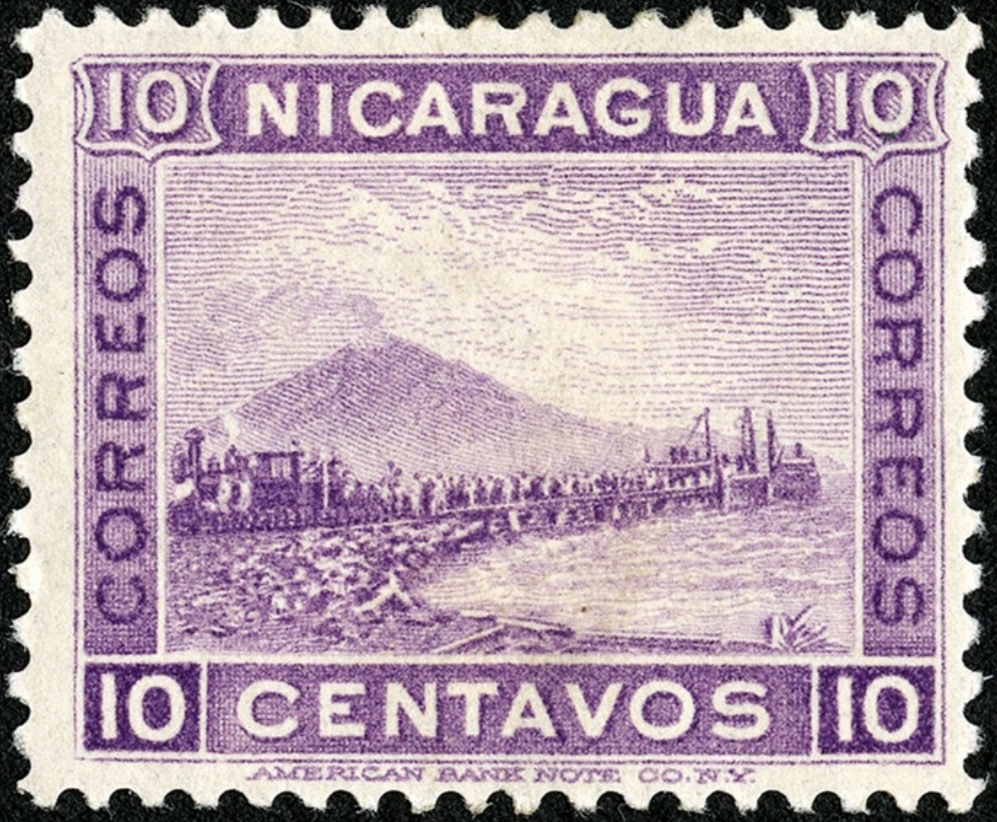
10 Centavos stamp of Nicaragua that created history 

On August 15, 1914, the Panama Canal officially opened when the S.S. Ancon steamed through from the canal's Atlantic to Pacific side. The canal, 82 km long waterway was an engineering marvel at that time, and the result of thirty years of toil. The Panama Canal, completed in 1914 by the United States after construction by the French, was an important innovation in sea travel in the early 20th century because it created an easy connection for ships traveling between the Atlantic and Pacific Oceans. The canal saved time in a journey that would otherwise have taken a ship from the East Coast around Cape Horn, at the southern tip of the Americas to the west coast. This journey would have been about 14,000 miles or around five months. While a canal built in Central America would reduce travel time. It was not always inevitable that this canal was going to be built in Panama.


The various routes proposed for a possible link

In the early 1900s, American politicians wanted to build a canal to bridge the distance between the Atlantic and Pacific Oceans, but were divided on where to build it, in Panama or in Nicaragua. Many members of Congress originally viewed Nicaragua as a safer choice when planning where to construct the canal The first attempt by the French to construct a navigable canal between the Caribbean Sea and the Pacific Ocean was stopped by landslides, an outbreak of malaria and yellow fever causing the death of almost 22,000 workers and a financial loss of almost 187 million dollars.

When the US Canal Commission took up the project they initially proposed an alternative, much longer route, that passed through Nicaragua. Phillippe Bunau-Varilla, an engineer who'd also been involved in the French project, was convinced that the terrain of Nicaragua was even more  hostile for the construction of a canal, and set out to lobby the US Congress in favour of the Panama route.                                           

This 5 Cent stamp from the Panama Canal Zone, depicts where-about the canal wound up being built

From a stamp dealer in Washington, he purchased 500 Nicaraguan stamps depicting the smoking Mount Momotombo, located near Lake Nicaragua  where the proposed Nicaragua Canal would pass. He sent a letter prominently featuring the stamp and a note reading ''An official witness to volcanic activity in Nicaragua'' to every US Senator and member of the House of Representatives.


This stamp is an example of one of the 1900 Nicaraguan stamps sent by Buanu-Varilla to members of the Congress. The reference to industry in the foreground and the smoking Mt Momotombo in the background, 10 Centavos postage stamp                                           

Bunau-Varilla message was simple. if active volcanoes are so common in Nicaragua that they feature so prominently on stamps, this was not the right country to build a canal. When voting took place the next day, the majority of politicians voted for the Panama route, and in 1904 construction work on the canal resumed. The Canal was completed on 15 August 1914. 


Spanish labourers in the Canal, 1914 (Library of Congress)
   

Just one year later, Nicaragua's Mount Momotombo erupted. 


Postage stamp that changed history


Tuesday, March 29, 2022

Karauli State (1348-1949) and Coins


Karauli State was a princely state in India from 1348 to 1949. It is located in the Braj region. Karauli  city was the capital while Mandrayal or Mandrail was another important town. The Maharaja of Karauli is considered as the head of the Jadon clan of Rajputs and claim to be descendants of Krishna. The Jadons once ruled the kingdom of Braj which included Alwar, Bharatpur, Karauli and Dholpur.


One Rupee, Harbaksh Pal (Muhammad Akbar II), 1808-1838.

The state had an area of 3,178 square km. In 1901, the population was 156,786 and that of the town was 23,482.   


Karauli State in the Imperial Gazetteer of India
                                 

In 1196, Kunwar Pal lost all of his territories to the invading Ghurids. One of the scions called Arjun Pal was able to recover some of his ancestral lands and founded the town of Karauli. The Jadons remained independent for a century, until their lands were once again captured by Mahmud I of Malwa. They gained patronage under Emperor Akbar, and Gopaldas was made the Maharaja. He also played an important role in the foundation of Agra Fort on orders from the Mughal emperor.


Flag


Coat of Arms


Karauli concluded the treaty with the British in November 1817. The Maharaja, Harbaksh Pal Deo, had accepted a ''protectorate'' treaty through his agent at Delhi. In 1857, at a time of the ''First war of Independence'', Madan Pal lent a support to the English. For his loyalty, Madan Pal was made Grand Commander of the Order of Star of India. The salute of honour, to which the Chiefs of Karauli were entitled, was also enhanced from 15 to 17.


H.H. Maharaja Ganesh Pal Deo of Karauli (1947-1984)


Karauli City Palace, built in 1635


Bhanwar Vilas Palace, built in 1938 by Maharaja Ganesh Pal Deo 


After India's independence in 1947, the state under Maharaja Ganesh Pal Deo acceded to India in April 1949, and became part of the state of Rajasthan. 


Coins of Karauli State


1/2 Paisa, Victoria, 1886, copper, weight 9.6 gm


Takka, Muhammad Akbar II, 1815-1834, copper, weight 17.8 gm


Takka, Arjan Pal, 1881-1886,copper, weight 17.7 gm


One Rupee, Muhammad Akbar II (Harbaksh Pal), 1223-1254 AH (1808-1838 AD), silver weight 11 gm, reverse has regnal year 24


One Rupee, Queen Victoria, 1852, silver, weight 11 gm, Regnal year 13


One Rupee, Queen Victoria, 1859, silver, weight 11 gm


One Rupee, Queen Victoria (Bhanwar Pal), 1882-1897, silver weight 11 gm, Obverse: Inscription ''The exalted Queen, Emperor of India, AD Date and mark of Bhanwar Pal, Reverse: Regnal year


Karauli Princely State

Coins of Karauli State
 

Rome vs Persia, 260 AD.

  In 260 AD, the unthinkable happened. The Roman Emperor Valerian I was captured alive by the Sasanian Emperor Shapur I, following the Battl...