Friday, June 18, 2021

Chutus of Banavasi ( forgotten Kingdom of Deccan) and Coins


The Chutus ruled a kingdom centered around the city Banavasi in present-day Karnataka for over two centuries, from 78 AD to 345 AD. The Chutus were probably subordinate to the Satavahanas in the beginning and assumed independence when the Satavahana power declined. They were one of the several dynasties described collectively as ''Andhra-bhritya'' in the Puranas. 


Coin, Chutus of Banavasi, Mulananda 

The word ''Chutu'' in Kannada means ''crest'' Chutu inscriptions contain the emblem of the cobra hood implying Chutu meant the ''cobra crest''. This also connects them to the Nagas tribes as they were associated with the region of Nagara Khanda around modern Banavasi 


       Map showing location of Banavasi, Karnataka


Coins of Chutus were first found at Karwar, a town near Banavasi in 1833, then from excavations at Chandravalli (Chithradurg) in 1908 and in 1947 from Chandravalli excavations.


       Madhukeshwara Temple, Banavasi

Numismatic evidence suggests that the Chutus were surrounded by other Satavahana feudatories, the Kuras of Kolhapur in the north and the Sadakana Maharathis of Chandravalli. The coins of the three families are similar, and most of the coins, can be dated to the 2nd century AD. By the last quarter of the 2nd century, the power of these three feudatory families was eclipsed by the Satavahanas, who appear to have assumed greater control over their territories.


     Sirsi, Sahasralinga, near Banavasi
 

When the Satavahana power declined in the first half of the 3rd century AD, the Chutus retained their authority at Banavasi, unlike the Kuras and Sadakana Maharathis. Their rule is attested by at least four inscriptions dated between 260 AD and 340 AD. They appear to have controlled Kunkalli, Balli and Konkan in present day Goa, as subordinates of the Bhojas


       Madhukeshwara Temple at Banavasi

Chutu dynasty came to an end probably in the first or second half of the 3rd century, around 250-275 AD. Of the Chutu dynasty two kings are known through inscriptions, Hariti-putra Chutu-kadananda Satkarni and his grandson Hariti-putra Siva-skanda-varman, who ruled in Banavasi before the Kadamba dynasty.

The Chutus appear to have continued the policy of consolidating their power by intermarriage with their neighbours (Ikashvaku dynasty) and the Satavahana dynasty. The designs on the Chutu coins suggest that they were Buddhists. 


Tree in 12 bracketed railing, Triratna symbol on the coin

The Chutu rule seems to have ended when Mayurasharman established the Kadamba dynasty with its capital at Banavasi in 345 AD.

Coins of Chutus of Banavasi


Chutus, Karshapana, 78-175 AD, Mulananda, lead, weight 10.2 g, Obverse: 8 arched hills with river below, legend in Brahmi reads ''ra no mu la nam da sa'' Reverse: Tree in 12 bracketed railing, Triratna symbol.


Lead coin of Chutus of Banavasi, Obverse: Ten arched hill, river symbol below, Reverse: Srivatsa 


Chutus of Banavasi, 78-175 AD, Mulananda, lead, weight 13.9 g
Obverse: 8 arched hills with river symbol below and Brahmi legend around ''Rajno Mulanamdasa''
Reverse: Tree in railing with 4 compartments, nandipara and swastika on left


Chutus of Banavasi, 175-280 AD, Lead, Sivalananda, weight 13.4 gm
Obverse: 8 arched hill, Brahmi legend around ''Rajno Sivalanamdasa
Reverse: Railed tree within 12 compartment railing, bow and arrow at right 


Chutus of Banavasi, 78-175 AD, Mulananda, lead 2nd century AD, weight 11.8 g
Obverse: 8 arched hills with Brahmi legend around, 
Reverse: tree in 12 compartment railing, Triratna symbol right 


Chutus, Chatukulanda 70 AD, lead, weight 17.3 g
Obverse: 8 arched chaitya, river symbol below, Brahmi legend ''rano chatukulaman dasa''
Reverse"tree in railing, nandipara/triratna left, swastika below, indra-dhvaj below.


Chutus of Banavasi, Mulananda, 78-175 AD, lead, weight 13.2 g, Obverse: 8 arched hill, Brahmi legend around, ''Rajno Mulanamdasa, Reverse: tree in 12 compartment railing, nandipara on right


Sunday, June 13, 2021

Kartikeya / Murugan, Constellations and Coins


Kartikeya, also known as Murugan, Skanda, Kumara, Mahasena and Subrahmanya, is a Hindu god of war. He is a son of Parvati and Shiva, brother of Ganesha, and an important deity since ancient times. Kartikeya is particularly popular and predominantly worshipped in South India, Sri Lanka and Malaysia as Murugan


 Kartikeya on Kumaragupta coin 415-455 AD


Kartikeya is an ancient god, traceable to the Vedic era. He is found in many medieval temples all over India and at the Ellora Caves and Elephanta Caves. The iconography of Kartikeya varies significantly. He is represented as an ever-youthful man, riding or near an Indian Peacock, dressed with weapons sometimes with a rooster in the flag he holds. 


Sculpture of Kartikeya, Brihadishvara Temple, Thanjavur, Tamil Nadu, India
 

There are references in the works of Panini (500 BC), in Kautilya's Arthashastra and in hymn 5,2 of the Rig Veda. One of the major Puranas, the ''Skanda Purana'' is dedicated to him. 


Carved figure of Kartikeya Aihole, Bagalkot, Karnataka

Kartikeya's presence in the religious and cultural sphere can be seen from the Gupta age. Two of the Gupta kings, Kumaragupta and Skandagupta, were named after him.


Sculpture of God Skanda, from Kannauj, North India, 8th century


The Kushans, who ruled from present day Peshawar, and the Yaudheyas, a republic clan in Punjab, struck coins bearing the image of Skanda as did the Ikshvakus, an Andhra dynasty and the Guptas.  


Kartikeya with a Kushan devotee, 2nd century AD


Skanda statue from Prey Veng Province, Cambodia
  

Kartikeya's popularity in North India receded from the Middle Ages onwards, and his worship is today virtually unknown except in Delhi, (Malai Mandir), in Haryana at Pehowa, where temple is dedicated to him and in Punjab, a temple stands at Achaleshwar, near Batala. 


Kartikeya temple, Pehowa, Haryana, India


In South India, Muruga has continued to be popular and many of his names are of Tamil origin. These include Senthil, Arumuga and Maal-Marudan. The main temples of Murugan are located in Southern Tamil Nadu. He was a god for the Ikshvakus, in Andhra Pradesh and eight of the early Pallava dynasty rulers (300-500AD) were named after Skanda or Kumara, suggesting his significance by then,


Kartikeya Maruthamalai temple in Coimbatore (12th century)
        

In Sri Lanka, the sylvan shrine at Kataragama, the temple in Tirukovil, the shrine in Embekke and the famed Nallut Kandaswamy temple in Jaffna are dedicated to him. Malaysia has several temples, the most famous being the Batu Caves near Kuala Lumpur, having a 42.7m high statue of Murugan. Temples of Murugan are famous in Singapore, the United Kingdom and Australia too.


Statue of Kartikeya in Batu Caves temple, Kaula Lumpur
   

Kartikeya means ''of the Krittikas''. This epithet is also linked to his birth. Krittikas in Hindu texts is called Pleiades in Greek texts. They are a cluster of stars in the constellation of Taurus, called the ''seven sisters'' and sit on the neck and shoulder area of Taurus the Bull. In Vedic lore they were the wives of the ''Sapt Rishis''or the ''Ursa Major'' constellation. In Vedic astronomy the Pleiades cluster is known as the ''Krittika nakshatra''. The sisters had moved away to nurse the infant God except one who stayed behind. Kartikeya is represented with six heads too.


The Pleiades, seven stars in the Taurus 


Orion, Taurus and the Pleiades, Sky Chart map


A six-headed Kartikeya riding a peacock by Ravi Varma

Orion and Kartikeya. As Kartikeyan is also known as ''the hunter'', he has been identified with the constellation ''Orion'' facing the charge of the Bull. Like Orion, Kartikeya is renowned for his enormous strength. Orion is generally shown in the star maps holding a club in his right hand. Although the spear is his favourite weapon, he also wields a club.                                              

The specific symbolic connections between them can also be seen from the ''Dendera Zodiac'', which is inscribed on the ceiling of the Temple of Hathor in Dendera, Egypt built during the Ptolemaic Period (305-30 BC)


The Dendera zodiac as displayed at the Louvre, Paris


Dendera Zodiac with original colours (reconstructed)

On the Dendera Zodiac, Orion is called Sah, holds a scepter and has a ''bird'' and a ''Rooster/Peacock'' behind him. The Rooster/Peacock is also a popular symbol of Kartikeya. This can be seen on a number of coins issued by the Yaudheya rulers in India. Thus, Kartikeya may be associated both with Orion and the Sah on the Zodiac and may open up a new understanding about the legends of Kartikeya killing the buffalo-demon, ''Mahisha'' as Orion faces the charging Taurus the bull. Thus, the Pleiades constellation is symbolised as the ''spear'' being thrust into the shoulder of the charging Bull, in order to slay ''Mahisha''.


A sketch of the Dendera Zodiac, the striding Sah/Orion carries a ''war scepter'' and wears the White Crown of Upper Egypt. Source, Wikimedia Commons. Public domain 


On the Harappan tablet H95-2486, the spear has been thrust into the shoulder of the charging buffalo, and this is exactly where the Pleiades are located on the star map.


Harappa molded tablet H95-2486 depicting Kartikeya killing Mahisha with his spear. The legend of Orion facing the charge of Taurus, the Bull


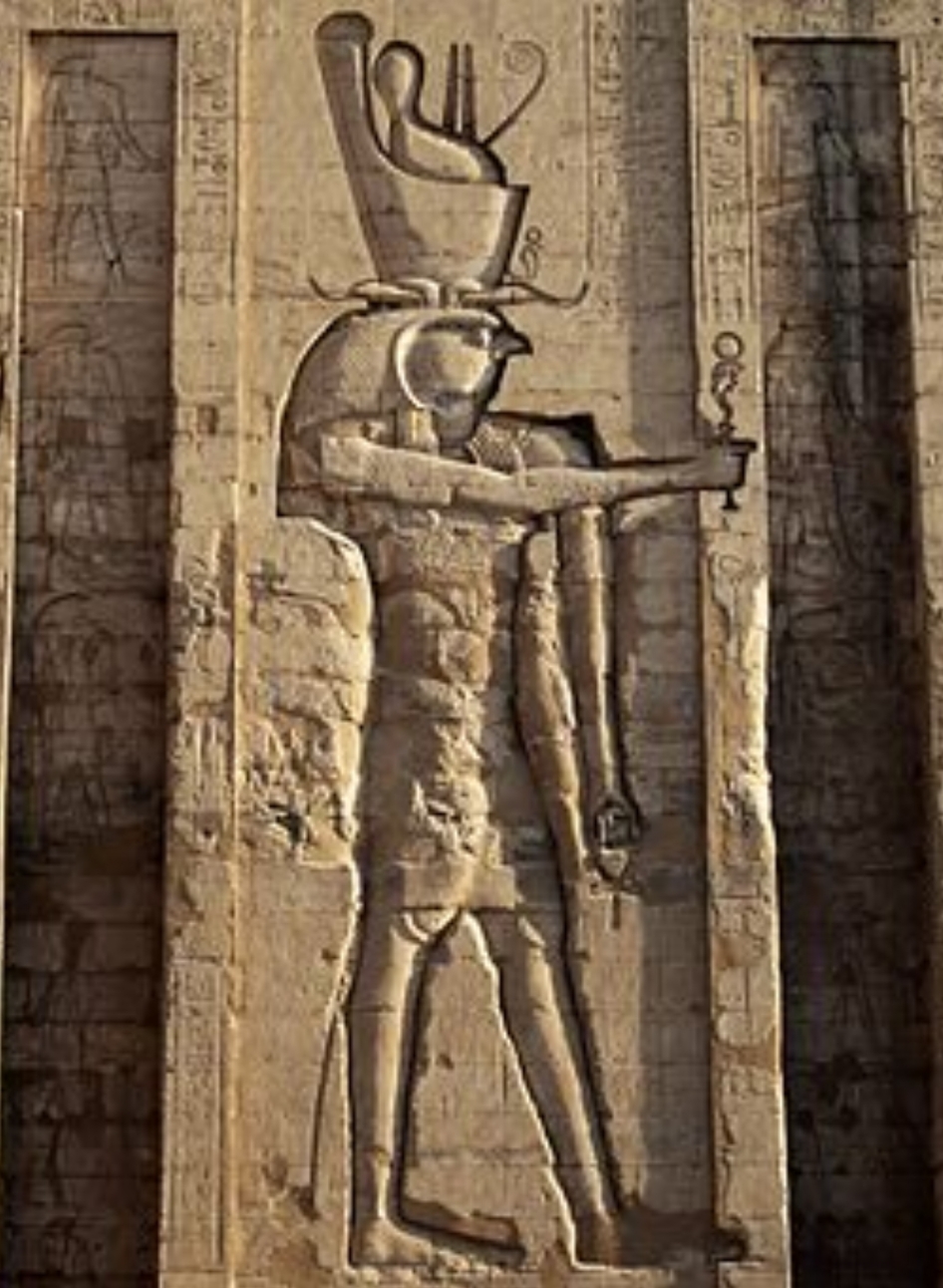
 In Egyptian ancient texts Orion constellation is sacred to Horus, the falcon headed sky god. As per the Egyptian texts, Hathor was Horus's consort and his mother and is manifested as the ''Seven Hathors'' identified with the seven stars of the Pleiades. 


           Horus depicted as a falcon.
  

Thus, there are similarities between Karthikeya and Horus at mythological and iconographical levels and maybe they are the same deity in different cultures. They were both even nurtured by the Pleiades sisters.

Coins depicting Kartikeya/Murugan


Kumaragupta I, gold dinar, 415-455 AD, weight 8.3 g
Obverse: King standing left, left hand on hip, right hand out-stretched, peacock standing at left, circular Brahmi legend around
Reverse: Kartikeya seated facing on a peacock, holding spear with left hand, right hand outstretched, scattering coins, Brahmi legend at right; Mahendrakumarah


Kumaragupta I, gold dinar, 415-455 AD, weight 8.2 g
Obverse: King standing left, left hand on hip, right hand out-stretched, peacock standing at left, circular Brahmi legend around
Reverse: Kartikeya seated facing on a peacock, holding spear with left hand, right hand outstretched, scattering coins, Brahmi legend at right; Mahendrakumarah


Kushan Empire, Drachm, 300-340 AD, weight 11.3 g
Obverse: Kartikeya standing facing, holding scepter, peacock at right, inscription in Brahmi around, lettering Yaudheya Ganasya Jaya
Reverse: Female goddess standing left with hand on hip


Yaudheya, 3rd century AD, weight 11.1 g, Obverse: Kartikeya standing facing, holding scepter, peacock at right, inscription in Brahmi around, lettering Yaudheya Ganasya Jaya, Reverse: Female goddess standing left with hand on hip.


Yaudheya, 2nd century AD, weight 11.2 g
Obverse: Kartikeya standing facing, holding a spear in right hand, with a rooster near his left foot, Brahmi legend around, lettering Yaudheya ganasaya jaya around
Reverse: Devasena goddess standing slightly turned to the left with right hand extended


Sikandagupta, Drachm, 455-480 AD, weight 2.30 g, Obverse: Kings bust facing right with traces of date, Reverse: Fan tailed peacock facing with wings spread, Brahmi legend around: Vijita vanir avanipati jayati divam Skandaguptoyam.


Yaudheya, 201-401 AD, copper, weight 10.7g      
Obverse: Karttikeya standing hoding spear in right hand with a bird near left foot, Brahmi legend around
Reverse: Goddess Devasena standing while slightly turned to left with right hand extended, all flanked by kalasha and nandipara.


Thursday, June 10, 2021

Shunga/Sunga Empire (185-73 BCE) and Coins


The Shunga or Sunga Empire was an ancient Indian Brahmin dynasty from Magadha that controlled areas of the central and eastern Indian subcontinent from around 184 to 75 BCE, about 50 years after Ashoka's death. 


                          Shunga coin 150 BCE
 

Emperor Brihadratha Maurya, the last ruler of the Maurya Empire, was assassinated by his commander-in-chief, Pushyamitra Shunga. Pushyamitra, then ascended the throne and became the ruler of Magdha and neighbouring territories. Its capital was Pataliputra, but later emperors such as Bhagabhadra also held court at Besnagar (modern Vidisha) in eastern Malwa. 


              Man on a Relif, Bharhut, Shunga
 

The Shunga controlled Ayodhya, as is inscribed on the ''Dhanadeva-Ayodhya inscription''. Dhanadeva, is claimed to be the sixth descendant of Pushyamitra Shunga. The empire extended upto present day Sialkot in Punjab and upto the Narmada River in the south.


             Map of The Sunga Empire, 180 BCE
     

 Pushyamitra ruled for 36 years and was succeeded by his son Agnimitra.

Among the 10 Shunga Emperors that ruled from 185 to 73 BCE, a few like Pushyamitra are known to have revived the supremacy of the Brahmanical religion and reestablished Yajnas that had been prohibited by Ashoka and the Mauryan Empire.  He is frequently linked with the persecution of Buddhists and a resurgence of Brahmanism.


                      Shunga horseman, Bharhut

He may also have been the reason for the original Sanchi stupa that was vandalized sometimes in the 2nd century BCE. Though majority if the Shunga emperors were seen as amenable to Buddhism, as they have contributed to the building of the Stupa at Bharhut and improving the Sanchi Stupa, by covering the brick with stone. Further support for Buddhism by kings Brahamamitra and Indragnimitra is recorded at the Mahabodhi Temple in Bodh Gaya. 


Shunga period Stupa at Sanchi, Stupa No 2, entirely Shunga work, 2nd century BCE.


Stupa No3, Stupa and balustrades only are Shunga.


War and conflict characterized the Shunga period. They are known to have been in battle with the Kalingas, Satavahanas, the Indo-Greeks and possibly the Panchalas.


                  Extent of the Shunga Empire


Mathura, however, was under control of the Indo-Greeks during the 1st century BCE, as inscribed on the ''Yavanarajya inscription'' also called the '' Maghera inscription'', discovered in Mathura.


The Yavanarajya inscription, dated to ''year 116 of Yavana hegemony'', probably 70 or 69 BCE, was discovered in Mathura Museum


Art, education, philosophy and other learning flowered during this period. Most notably, Patanjali's Yoga Sutras and Mahabhashya were rejuvenated during this period, and devotion that anyone could practice.

 The richness of India's spiritual tradition, from which the whole world has gained insight, owes much to this period. 

Artistry on the subcontinent progressed with the rise of the Mathura school, which was considered the indigenous counterpart to the Hellenistic Gandhara school (Greco-Buddhist art).


Shunga woman with child, 2nd - 1st century BCE.


The script used by the Shunga was a variant of the Brahmi and was used to write the Sanskrit language. The script is thought to be an intermediary between the Maurya and the Kalinga Brahmi scripts.

After the death of Agnimitra, the second king of the dynasty, the empire began to disintegrate. Inscriptions and coins indicate that much of northern and central India consisted of small kingdoms and city-states that were independent of any Shunga hegemony. The last king of Sungas, Devabhuti was assassinated by his minister Vasudeva Kanva, who the established Kanva dynasty


Coins of Shunga dynasty


Half Karshapana, Sunga dynasty, 185-73 BC, copper, weight 2.75 g, Obverse: Elephant to left Reverse: Chaitya, three arched hills with crescent above.


Quarter Karshapana, Sunga kingdom, 150 BCE-75 AD, copper, weight 2.50 g, Obverse: Three arched Chaitya/ stupa surmounted with a crescent on top, Hollow cross, Taurine, Tree in railing, Reverse: Elephant, Swastika, Taurine, Indra- Dhwaj


Quarter Karshapana, Sunga dynasty, 200 BCE-100 BCE, copper, weight 1.5 g, Obverse: Elephant with rider, Reverse: Chaitya, three arched hills with crescent above


Quarter Karshapana, Sunga dynasty, 200-100 BCE, weight 1.18 g, Obverse: Lion standing left, miscellaneous symbols around, Reverse: 5 arched hills with tree on top, flanked by inverted taurines


Quarter Karshapana, Sunga dynasty, 185-73 BCE, copper, weight 2.2 g, Obverse: Elephant to left, mounted by a Sunga king, Reverse: Chaitya, Three arched hill with crescent above.


Quarter Karshapana, Sunga kingdom, 150 BCE-75 AD, copper, weight 2.35 g, Obverse: Three arched Chaitya/ stupa surmounted with a crescent on top, Hollow cross, Taurine, Tree in railing, Reverse: Elephant, Swastika, Taurine, Indra- Dhwaj        


Karshapana, Sunga kingdom, 200-100 BCE, copper, weight 3.9 g, Obverse: Hollow cross with an arrow shooting out of each arm, Reverse: Tree in railing.


Karshapana, Shunga kingdom, 185-75 BCE, copper, weight 3.02 g, Obverse: Tree inrailing, Reverse; Chaitya, Three arched hill with crescent on top


Karshapana, Shunga kingdom, 150 BCE-75 AD, copper, weight 3.60 g, Obverse: Three arched Chaitya/ stupa surmounted with a crescent on top, Hollow cross, Taurine, Tree in railing, Reverse: Elephant, Swastika, Taurine, Indra- Dhwaj        


Shunga Dynasty

Shunga Dynasty coins

Rome vs Persia, 260 AD.

  In 260 AD, the unthinkable happened. The Roman Emperor Valerian I was captured alive by the Sasanian Emperor Shapur I, following the Battl...